

Short answer: most well-known sportswear companies are brands: they design, market and sell, and much of their production is made by independent factories. A sportswear manufacturer in China is one of those factories. Factories specialise by product and process, so the useful question is not “which is the biggest sportswear company” but “which kind of factory makes my product, at my volume, with evidence I can check”.
Some brands publish the factories they use; for example Nike’s Manufacturing Map lists independent factories and material suppliers. That kind of disclosure shows how brand and factory are separate, but it is not a list of factories open to new customers.
Types of sportswear factory
| Factory type | Typical products | What it is set up for | Questions to ask |
|---|---|---|---|
| Cut-and-sew performance knit | Leggings, tops, shorts, sports bras, compression | Elastane knits, flatlock and coverstitch seams, elastic waistbands | Which stretch fabrics it runs in bulk; seam types available; recovery testing |
| Seamless circular knit | Seamless leggings, bras, base layers | Knitting garments to shape on seamless machines | Machine gauge and size range; development time for a new pattern |
| Sublimated teamwear | Team jerseys, cycling and running kits | All-over sublimation on polyester, name and number personalisation | Colour management; per-garment personalisation checks |
| Fleece and casual sport | Hoodies, joggers, sweatshirts | Brushed fleece, French terry, rib trims | Shrinkage control; print and embroidery on fleece |
| Woven and technical outerwear | Running jackets, shells, windbreakers | Woven fabrics, taping, coatings | Seam sealing; water-resistance testing |
A factory may cover more than one type, and many use subcontractors for printing or specialist processes. Ask which steps are in-house and which are subcontracted, and who controls quality at each.
Brand, factory, trading company or sourcing agent?
Search results for sportswear companies and manufacturers mix four kinds of business. Knowing which one you are talking to changes what you can ask for.
| Business | What it does | How to tell |
|---|---|---|
| Brand | Designs, markets and sells under its own name; usually contracts out production | Sells to consumers; does not quote for your designs |
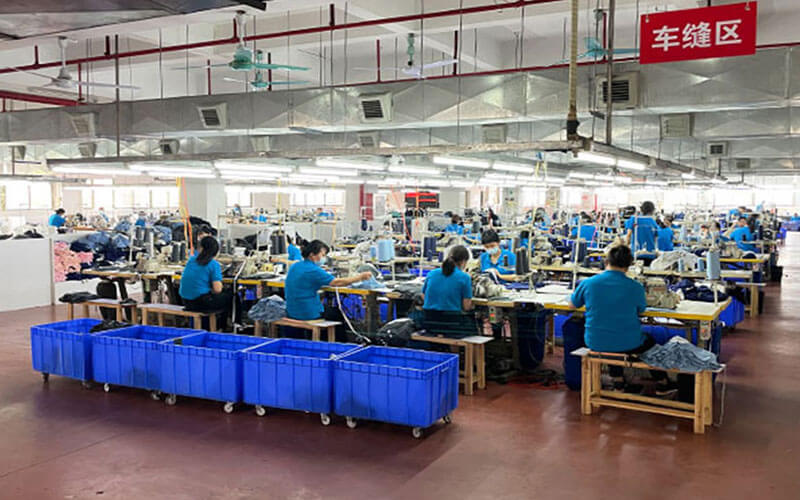
| Factory (manufacturer) | Cuts, sews and finishes garments for brands | Can show its production floor, machine types, and the processes it runs in-house |
| Trading company | Sells and manages orders, places production with factories | Quotes widely across categories; factory address and audit belong to someone else |
| Sourcing agent | Works for the buyer to find and manage factories, usually for a fee or commission | Represents you, not the factory; check how it is paid |
None of these is wrong to work with, but you should know which you are dealing with, who holds the production risk, and whose audit and documents you are relying on. See sourcing agent or direct factory.
What to specify before you approach a factory
- Activity and intensity. Yoga, running, gym and team sport put different loads on fabric and seams.
- Fabric family and the properties you need: stretch and recovery, opacity when stretched, moisture behaviour, pilling. Use named tests such as ASTM D2594, AATCC TM195 and ISO 12945-2 when a property matters.
- Seam and construction: overlock, flatlock, coverstitch or bonded, chosen for where the seam sits and how much it must stretch.
- Programme type: retail line, team order with personalisation, or gym and club merchandise. Each changes size ranges, minimums and inspection.
- Claims: recycled content, moisture-wicking or anti-odour. Each needs evidence; see recycled polyester proof and performance claims testing.
How to shortlist a sportswear manufacturer in China
- Match the factory type to the product. A seamless specialist and a cut-and-sew factory are not interchangeable.
- Ask for comparable work. A garment it already makes in your fabric family, with its spec sheet.
- Send the same brief to each candidate. See what each asks back; a factory that asks about activity, recovery and seams has read the brief.
- Pay for a sample and test it. Wear, wash and measure; check opacity in a squat for leggings.
- Check documents. Business licence, any audit reports you rely on, and supply-chain documents for U.S. imports (UFLPA).
- Compare landed cost and total lead time, not unit price. Confirm the Incoterms rule each quote uses.
Minimums and sampling
Minimums are usually set per style and colour, and performance fabrics often carry their own mill minimum per colour. Sampling normally runs from a development sample to fit, size set and pre-production approval. See what a small activewear order costs, how MOQs work and sample approval.
Fact, advice and uncertainty
Fact: sportswear brands and sportswear factories are usually different companies, and factories specialise by product and process. Advice: shortlist by factory type and evidence, then compare on a paid, tested sample and landed cost. Uncertainty: tariffs, freight and factory capacity change; check them at the time of ordering.
Knitwear Base is a knit apparel manufacturer in China making cut-and-sew activewear, compression and basics; we are one option, not a neutral ranking. Related pages: custom sportswear development, compression clothing, sportswear sizing and team sportswear ordering. To discuss a project, use the contact page.
Sources and further reading
- Nike, Manufacturing Map (independent factories and material suppliers used to make Nike products)
- ASTM D2594/D2594M, Stretch Properties of Knitted Fabrics Having Low Power
- AATCC TM195, Liquid Moisture Management Properties of Textile Fabrics
- ISO 12945-2:2020, Fabric propensity to surface pilling, fuzzing or matting: modified Martindale method
- U.S. Customs and Border Protection, Uyghur Forced Labor Prevention Act
- ICC, Incoterms® 2020 rules
- ISO 2859-1:2026, Sampling procedures for inspection by attributes (AQL)
Rules and standards are summarised from their official pages for general guidance; this is not legal advice. Check the current version and the requirements of your own market before you rely on them.
