
Custom sportswear is a development project in which the fabric does part of the pattern’s work. A performance knit stretches, so the block can be cut closer than a casual garment, and the same property means a small measurement error is more visible in wear. That is why the commercial terms in this category matter as much as the technical ones: the pattern, the grade and the seam specification are the assets that let a brand reproduce a performance fit.
Custom Sportswear Manufacturer: what to confirm before you send a tech pack
The brief should state the activity and the intensity, because those determine the tension the garment is designed to carry, and tension determines the pattern. It should then fix the fabric direction, the seam type at each join, the size range and the branding. On a performance garment the recovery expectation belongs in the brief rather than in the sample comments, because it decides how much negative ease the pattern can carry.
Two further items are worth stating. The intended fit — compressive, fitted or relaxed — since the same block cannot serve all three. And the care regime, because a performance garment is washed frequently and the pattern loses its meaning if the fabric relaxes after a few cycles. Both are cheap to state and expensive to discover after the pattern has been made.
It is also worth naming the market the range sells into, because labelling and testing expectations differ between destinations and the seller of the finished goods carries the obligation. The European Commission’s textiles and clothing framework sets out the EU position on fibre naming and labelling, and establishing the destination in the brief means the label text and any testing requirement are planned with the fabric order rather than added later.
What to verify on a sportswear factory before committing to a knit first order
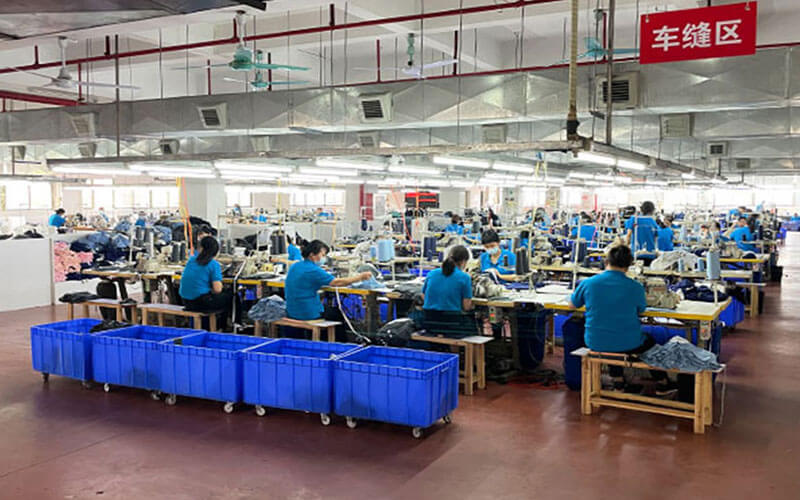
Verification should test the fabric handling rather than the general size of the business. Performance knits need different tension settings, needle plates and seam types from casual jersey, and a factory that produces basic knits may be able to sew a performance garment without being able to make it recover correctly. The specific checks are which performance fabrics the factory runs routinely, which seam types it uses, and how it tests recovery.
Three pieces of evidence shorten the exercise: a comparable specification and sample from a performance garment the factory has produced, a business licence confirming the entity, and a written statement of which processes run on site and which are bought in. Buyers should ask all three before the first order, and should ask specifically whether bonding, if used, is performed in-house, because that process is frequently subcontracted.
One further question is worth asking because it is difficult to recover from later: how the factory tests recovery. A supplier that can describe the test it applies, rather than describing the fabric as stretchy, is one that can hold a specification across production runs. That answer also tells the buyer whether the factory understands the difference between stretch and recovery, which is the property that decides whether the garment still fits at the end of a season.
| Term | What it means | How it is verified |
|---|---|---|
| Stretch | How far the fabric extends before it resists | Extension measured at a stated load |
| Recovery | How closely the fabric returns to its original dimension | Repeated extension followed by measurement |
| Opacity | Whether the fabric shows through when bent or stretched | Visual check under a stated light |
| Pilling resistance | How the surface behaves after abrasion | Abrasion test, scored against a reference |
The four terms are the ones that decide whether a sportswear programme is accepted by the customer rather than by the inspector, because each of them describes behaviour in use. Specifying them as numbers with a method attached is what makes them checkable, and it is also what makes a second order comparable with the first.
How size grading and size-ratio planning change a knit sportswear order
Grading a performance garment is different from grading a casual one because the garment is designed to be worn under tension. A measurement that is comfortable at the base size can become restrictive at the extremes, and the difference is felt rather than seen. The grade therefore has to be checked at the smallest and largest sizes in the intended fit, not on the flat table alone.
Ratio planning then converts that grade into an order. Performance ranges often concentrate demand in the middle sizes because the fit is tighter, and a ratio weighted towards the middle is cheaper to cut and usually sells through better. Where the programme serves a team rather than a retail channel, the ratio follows the squad distribution instead, which is a different calculation entirely. Buyers should state which of the two applies before the cutting plan is set.
What happens to the pattern and tooling if a knit sportswear programme changes supplier
The answer depends on what was agreed when the pattern was created, and in performance garments the stake is higher than usual because the fit depends on the fabric as well as the block. A pattern that fits in one performance knit does not automatically fit in another with different recovery, so a new supplier may need both the pattern and the original fabric specification.
A workable structure separates the reusable block from the specific pattern: the factory keeps the block it uses across its own work and releases the specific pattern, the graded set and the measurement specification for the styles the brand paid to develop. Buyers should name the file formats, the deliverable list and the payment trigger, and should record the fabric specification alongside the pattern so that the fit can be reproduced. The measurement tolerances matter as much as the measurements.
Two practical consequences follow. Where a specialised process such as bonding is used, the tooling for it also belongs to somebody, and the position should be recorded at the outset. And where the range runs several fabric weights, each weight may need its own sample confirmation even when the block is unchanged, because the same pattern behaves differently in a heavier or a more compressive knit.
Payment, deposit and sample-fee terms worth agreeing early on knit sportswear
A performance programme carries fixed costs that behave differently from garment costs. Pattern and grading are incurred once. Sample fees may or may not be credited against a first order. Where bonding or a specialised seam is used, that process often has its own setup and its own minimum, which is easily overlooked at quotation. A deposit structure that treats all of this as one line makes later changes hard to price.
The terms worth fixing early are the ones that prevent re-quotation: what the sample fee covers and whether it is credited, whether pattern work is charged separately, who owns the patterns and any tooling, how a specialised seam process is priced, and how a change to the brief is priced after approval. The ICC Incoterms rules settle where cost and risk transfer on delivery, which is a separate question from when the deposit falls due.
How to write a knit sportswear specification the factory cannot misinterpret
A specification fails when a term can be read two ways. “Compressive” and “moisture-wicking” are intentions, not instructions. A performance specification needs the fabric composition and weight, the stretch and recovery expectation, the seam type at each join, the opacity requirement under tension, and the measurement set with tolerances. It also needs the activity, because a garment built for running and one built for studio training carry the same description and different requirements.
Buyers should also name the tests that will settle a disagreement. The ASTM standards programme for textiles provides neutral vocabulary for the property under test, and testing houses publish the scope they apply to performance garments, as Intertek’s textiles and apparel testing range illustrates. Where a material claim is made, OEKO-TEX Standard 100 covers harmful-substance testing on the substrate.
The specification should also state the acceptance standard for the seam, because a seam failure under load is a functional defect rather than a cosmetic one. That means naming the seam type, the stitch density where relevant, and the test that confirms it holds after repeated stretching. A tolerance without a consequence for exceeding it leaves the question to be resolved commercially at the point where the buyer has least leverage.
How can I create my own sportswear brand?
Fix the activity, the fit and the fabric first.
The activity determines the specification, the fit determines the block, and the fabric determines whether that block holds its shape, so all three are settled before the styling.
Starting from the design reverses the dependencies. A brand that designs a legging before deciding whether it is built for studio wear or for running will specify the wrong fabric weight and the wrong seam, and the correction is a new pattern rather than an adjustment. Deciding the activity and the fit first reduces the development to a block that matches a known requirement.
Once those are fixed, the brand needs a measurement set with tolerances, a construction specification covering the seams and the elastic-bearing components, the fabric specification including recovery, and the branding assets. Knitwear Base’s sportswear programme runs alongside its compression and activewear ranges, and the recycled fibre route is covered in this piece on eco activewear at wholesale scale.
A final point concerns where the money goes on a first run. Because a performance garment carries a smaller margin for error than a casual one, it is usually better to spend on the pattern and the sample rounds than to save on the fabric, since a fabric that recovers poorly makes every subsequent order a problem. The assets the brand keeps, the pattern and the specification, are also the ones that reduce cost on the second and third orders.

Conclusion
Custom sportswear is a development project in which the fabric and the pattern are one specification. The activity and the intended fit determine the block, the recovery of the knit determines whether that block holds, and the seam type determines whether it survives use. The commercial terms matter because the pattern, the grade and the fabric specification are the assets that let a brand reproduce the fit, and a pattern without its fabric reference is only half a specification. Buyers who fix the activity and fit first, record the fabric alongside the pattern and name the tests get a performance product rather than a garment that looks like one.
FAQ
Why does the fabric specification have to be recorded with the pattern?
Because performance fit depends on the recovery of the knit as well as on the measurements. A pattern that fits in one fabric will fit differently in another with different stretch or recovery, so the two have to be held together for the style to be reproducible.
Should the grade be checked differently on a performance garment?
Yes. Because the garment is worn under tension, a measurement that is comfortable at the base size can be restrictive at the extremes. The grade should be checked at the smallest and largest sizes in the intended fit rather than on the flat table alone.
Does a specialised seam process carry its own cost?
Often yes. Bonding and some specialised seam processes are frequently subcontracted and carry their own setup, minimum and lead time, which is why they should be established at quotation rather than discovered during production.
Who should own the pattern for a custom sportswear style?
The practical answer is that a brand which does not hold it cannot move the style without re-developing the fit. A workable structure releases the specific pattern, grading and measurement specification on payment of a stated fee while the factory keeps its reusable block.
Next step. If you are developing a performance range, send the activity, the intended fit and the fabric direction you are considering. The team can confirm how the block would be graded, which seam type suits the garment, and which terms carry forward to later orders.
