
Quality control inside a factory is not the inspection room at the end of the line. It is a set of routines that run while the work is happening, because by the time goods reach final inspection the only remaining decision is whether to accept them. A factory that measures its quality system by its rejection rate is measuring the last step; one that measures it by the number of faults caught in-line is measuring the system itself.
Clothing Factory Quality Control: the system rather than the inspection
A working system has four parts, and inspection is only one of them. Work instructions that state how each operation is performed and what the result should measure. First-off approval, so that a pattern or placement error is caught before it repeats across the run. In-line patrol, so that a drifting setting is corrected while the machine can still be adjusted. And a defect record that is used to change something rather than simply to count.
The distinction matters because inspection and control answer different questions. Inspection asks whether the goods conform; control asks whether the process will keep producing conforming goods. A factory can pass an inspection and still have no control, which is why the same faults reappear on the next order.
Two inputs make the system possible. A specification the factory can work to, meaning a measurement table with a base size, tolerances and a grade direction rather than a chart of target figures. And a physical reference approved by the buyer and retained on site, because appearance questions are settled by comparison and not by description.
Where control points sit along a production line
Control points belong wherever a fault becomes expensive to reverse, which in garment production follows the order of the operations rather than the layout of the building.
| Point | What is checked | What it prevents |
|---|---|---|
| Incoming material | Shade bands, weight tolerance, visible faults | Cutting cloth that cannot be replaced |
| Cutting and bundling | Ply accuracy, panel match, bundle integrity | Mismatched pieces through the whole run |
| First-off | Pattern, placement and construction against the reference | An error that repeats on every piece |
| In-line patrol | Measurement drift, seam quality, attachment strength | Producing a batch that has to be reworked |
| Final | What the customer would see, feel or return | Shipping a lot that should have been sorted |
The list is deliberately short. A control plan with thirty checks that nobody performs is worse than one with five that are recorded, because the record is what makes the check a control rather than an intention.
Turning a sampling plan into a factory routine
A sampling plan is a buyer-facing document, and inside the factory it has to become a routine. That means a defined draw for each lot, a defined inspection point for each class of check, and a named person who records the result. The plan’s two halves still apply: the lot size fixes the sample, and the defect class fixes the acceptance number.
The routine is what makes the numbers comparable between lots. Where the same sample size and the same classes are used every time, the records form a series, and a series shows whether a process is improving or quietly drifting. Where each lot is sampled differently, the records describe individual decisions and nothing else.
The vocabulary used to describe the properties under test is published by the ASTM standards programme for textiles, and a testing house sets out the scope it applies to garments, as Intertek’s textiles and apparel testing range illustrates.
Defect classification and the accept/reject line on the floor
Classification has to reach the operators, not only the quality office. A critical defect makes the garment unsafe or unsaleable; a major defect affects function, fit or appearance in a way a customer would notice and return; a minor defect is visible only on close inspection and does not affect use. Where those three definitions are posted at the line and illustrated with the garment in hand, the classification stops being a judgement call made afterwards.
The accept and reject line then follows the plan rather than the mood of the inspection. Where a fault falls between two classes, the comparison that settles it is with the approved reference, which is why the reference has to be accessible during production rather than locked in an office.
One further practice keeps the system honest. Defects that recur in a run should be logged as a process finding rather than a piece finding, because a fault that repeats is telling the factory something about a setting, a method or a material that no amount of sorting will fix.
Measurement control at the point of sewing
Measurement control works best where the measurement is taken, not where the goods are finished. A supervisor measuring a garment as it comes off the line can adjust a setting; the same measurement taken at final inspection can only classify. Where the operation involves elastic, rib or a stretch fabric, the check has to include a recovery observation as well as a dimension, because a component that has been stretched during sewing may measure correctly and relax later.
Two habits make the data useful. Record the value rather than a pass or a fail, so that drift is visible before it becomes a defect. And measure at the base size and the extremes of the range, since a grade that holds in the middle frequently fails at the ends, and the ends are where the returns come from.
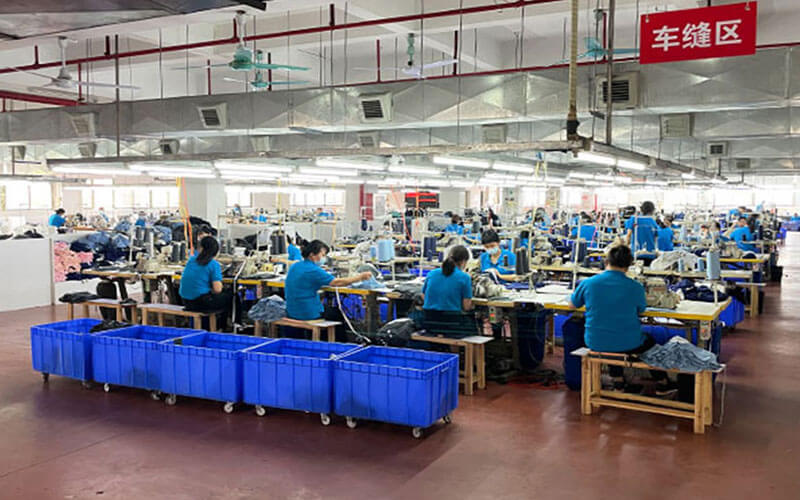
Fabric, colour and weight checks before cutting
The cheapest place to find a material fault is before the cloth is cut, which is why incoming checks carry more weight than their position suggests. Shade consistency between rolls is the check that cannot be recovered later, because shade variation discovered after cutting affects pieces that are already in the run. Weight against the stated tolerance is the check that most often reveals a substitution, and visible faults such as holes or weaving irregularities are the ones that waste the most cutting time when they surface later.
Colour is judged at two points rather than one, because a roll can be within tolerance and still read inconsistently once the garment is assembled. The comparison at that second point is against the approved standard in garment form rather than a colour card on its own. Harmful-substance testing follows OEKO-TEX Standard 100, whose certificate names the articles in scope.
Records: what a factory keeps, and for how long
Records are what turn a system into something that can be reviewed. Four sets carry most of the value: the inspection results by lot, the corrective actions with their closure evidence, the material certificates that support any claim made on the product, and the maintenance log for the machines whose accuracy the control plan depends on.
The retention period should be set by the longest claim the product carries. Where a buyer’s own customer can raise a question a year after delivery, a record kept for a season is not a record. The practical test is simple: could a question about a specific shipment be answered from the file without contacting the person who made it, and could a material claim be traced back to a roll of cloth.
Where the record is a corrective action rather than an inspection result, the format used in social compliance is worth copying, because it is designed to be closed rather than filed. amfori administers the BSCI framework and WRAP certifies facilities, and both structures require a named change, an owner and evidence before a finding is treated as closed.

What is quality control in the clothing industry?
Control is preventing faults; inspection only finds them.
In clothing production, quality control is the set of routines that keep a run inside a specification, chiefly material checks, first-off approval, in-line patrol and recorded measurements, with final inspection acting as the last gate.
The industry’s distinction between quality control and quality assurance is worth keeping clear. Control is operational and specific: the settings, the checks and the records that apply to this order. Assurance is the framework around it, which is what an audit examines when it reviews documentation, training and traceability. A factory can have a sound assurance framework and a weak control routine on one line, which is usually where the faults appear.
Facility-level measurement sits between the two and is increasingly used by brands to compare suppliers on a common scale; Higg publishes the index used for that purpose. It is a management tool rather than a control routine, and it does not replace an in-line check on a specific order.
The practical consequence for a buyer is that the questions worth asking are operational. Which checks run in-line, who records them, and what happens to the record. Those answers describe the system, while a claim about a certificate describes the framework.
What is AQL 2.5 in the garment industry?
An acceptance level commonly applied to major defects in a sampling plan.
In apparel inspection, AQL 2.5 is the acceptance quality limit most often applied to major defects, read together with the sample size to give an accept and reject number for the lot.
The figure is a parameter of the sampling plan rather than a defect percentage that the goods are expected to reach. The plan pairs a lot size with an inspection level to fix the sample, and the AQL column for the defect class to fix the acceptance number. Common practice in apparel applies a tighter figure to critical defects and a looser one to minor defects, on the principle that a broken seam and a loose thread should not count the same.
Two cautions follow. A plan agreed after production has already happened cannot influence the run, and a plan applied without a reference sample leaves the class of a fault open to interpretation. Where a buyer wants the plan to do work, it should be agreed with the specification and written into the order alongside the acceptance rule.
Conclusion
Quality control inside a factory is a routine rather than an event. Control points sit where a fault becomes expensive to reverse, first-off approval stops an error from repeating, in-line measurements catch drift while it can still be corrected, and the records are what allow the system to be reviewed later. The inspection at the end is the gate, not the system, and a factory that measures itself by what it catches in-line rather than by what it rejects at the end is the one whose second order looks like the first.
FAQ
What is the difference between quality control and inspection?
Inspection asks whether the goods conform; control asks whether the process will keep producing conforming goods. A lot can pass an inspection with no control in place, which is why the same faults tend to reappear on the next order.
Where should a factory place its control points?
Wherever a fault becomes expensive to reverse: incoming material, cutting and bundling, first-off, in-line patrol and final. A short list that is actually recorded is more effective than a long one nobody performs.
Does AQL 2.5 mean a 2.5% defect rate?
No. It is a parameter of the sampling plan that, combined with the sample size, produces an accept and reject number for a defect class. It is not a defect percentage the goods are expected to reach.
Why keep measurement records when everything passes?
Because a series of passing values shows whether a process is stable or drifting towards its tolerance. A pass or fail note cannot show drift, and drift is what produces the next order’s defects.
Next step. If you are setting up quality control for a programme, send the specification and the construction. The team can confirm where the control points belong for that garment, which checks can run in-line, and what the records would show.