
Every supplier directory is organised the same way, and the way it is organised is the problem: a list of companies under a single heading called clothing. No factory is good at clothing. A factory is fluent in a product family, and the fluency is made of specific machines, specific construction methods and specific finishing steps that do not transfer from one family to another. Selecting a supplier therefore starts with identifying which family you are buying, because that determines which capabilities have to be present.
Why “clothing manufacturer” is not a capability — category fluency is
A clothing manufacturer is fluent in a category, not in clothing. Capability means the machines, construction methods and finishing steps that one product family requires, which is why a factory excellent at fleece hoodies may be unable to hold a flatlock seam in compression wear.
The word manufacturer describes a legal and commercial role. It says nothing about the floor, because the same role is held by a workshop with twelve machines and by an integrated group running knitting, dyeing and assembly. What distinguishes them for a buyer is not size but whether the equipment and the construction vocabulary match the garment being ordered.
There are three layers of capability, and they are frequently conflated. The material layer, which is whether the factory knits its own fabric or buys it. The assembly layer, which is which stitch types and attachment methods it can execute reliably. And the finishing layer, which covers washing, pressing, bonding, printing or embroidery, and the inspection routine that follows. A supplier can be strong in the second and absent in the first, which is normal rather than a weakness, but it changes who carries the fabric lead time.
The practical consequence is that the useful question is not “can you make clothing” but “which category is your main volume, and what machinery does it run”. Answers to the second question are checkable, and they predict the quality of the first order far better than a catalogue of past customers.
| Product family | Machinery that has to be present | Where an unqualified factory fails |
|---|---|---|
| Knit basics | Coverstitch, flatlock, overlock, ribbing | Neckline recovery and hem stability |
| Underwear and intimates | Elastic handling, flat-seam or bonded lines | Waistband roll and leg-line comfort |
| Hoodies and sweatshirts | Loop-wheel or fleece finishing, ribbing, embroidery | Pilling at the brushed face and cuff recovery |
| Activewear and compression | Four-needle six-thread flatlock, bonding press | Seam failure under stretch and lost recovery |
| Loungewear and sleepwear | Fabric-variety cutting, set assembly, piping | Mismatched top-to-bottom ratio and shrinkage |
Knit basics: what a competent knit factory has to own
Knit basics are the broadest family and the one where capability is easiest to check, because the construction is standard. A factory working in this family has to hold a coverstitch machine for hemming and binding, a flatlock for seams that have to lie flat, an overlock for joining and edge finishing, and the ribbing capacity to make or attach neckbands that recover rather than stretch out.
The material decision sits alongside the machines. A vertically integrated knit factory producing its own single jersey, interlock or rib carries a fabric lead time it controls; a factory that buys fabric adds a mill lead time to the calendar and a shade risk to the order. Neither structure is better, but they are different supply chains and should be planned differently.
What fails first when a factory is out of its family is the neckline, because a ribband that is not knit or attached to the correct stretch ratio will open after washing irrespective of how well the rest of the garment is made. The construction that produces a stable neck on knitwear is set out in this overview of apparel design and development.
Underwear and intimates: the machinery and construction that decide quality
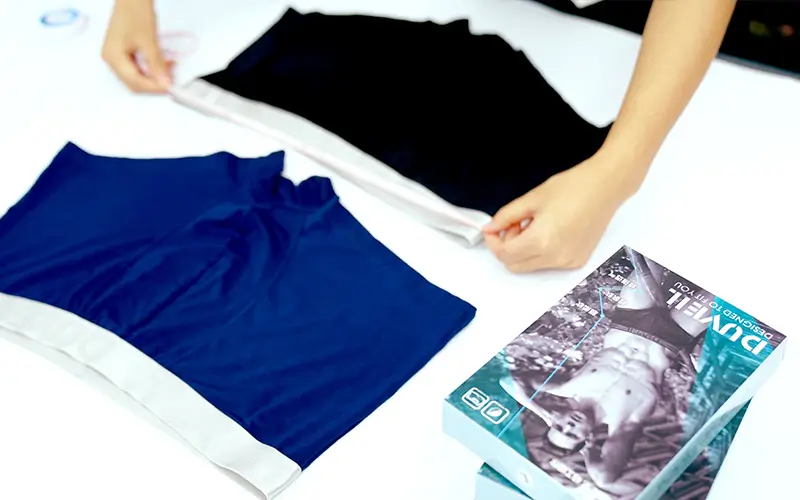
Underwear is a different manufacturing problem, and the difference is elastic. The garment is built around components that stretch, which means the factory needs the machinery to attach elastic under controlled tension, the construction to avoid seams that press against the body, and the measurement discipline to hold a graded fit across a pack rather than across a single size.
Three construction skills separate suppliers in this family. Attaching a waistband so that it neither rolls nor digs after washing. Forming a pouch or a leg opening without a seam in a position that creates friction. And controlling the stretch ratio of the opening so that the fit is comfortable at the top of the size range as well as the middle. A factory without those skills can still assemble a garment that looks correct flat and fails on the body.
The category also imposes a different view of size planning, because underwear is sold in packs and the pack ratio is a commercial decision rather than a manufacturing one. Because the fabric sits against skin for the whole wear cycle, material safety testing carries more weight here than in an outerwear programme, and OEKO-TEX Standard 100 names the article classes its certificate covers. The construction and grading questions specific to the category are described in this guide to the underwear manufacturer route.
Hoodies and sweatshirts: fleece, terry and the finishing line
Hoodie manufacturing is defined by the fabric family rather than by the silhouette. Fleece is built from a knitted ground with a looped face that is then finished differently to produce brushed, anti-pill or unbrushed surfaces, and the finishing route determines how the garment feels, how it pills and how much it shrinks. A factory that works in this family has to be able to state which finishing route it can run and what the shrinkage behaviour is after the care cycle.
The construction skills that matter are specific. Attaching ribbing to cuffs and a hem so that recovery persists. Setting a hood so that it sits correctly on the body rather than only on the table. Assembling a kangaroo pocket without distorting the panel in front of it. And executing the decoration, since embroidery is usual in this family and the placement and the backing change how the fabric behaves.
Because weight and finishing interact so strongly, a hoodie programme specified on weight alone will still produce two visibly different garments from two mills. The questions to ask about weight and finishing are set out in this guide to hoodie manufacturing.
Activewear and compression: stretch fabric handling and seam construction
Activewear and compression are the most machinery-specific families in knitwear, because the fabric is engineered and the construction has to preserve what the fabric was engineered to do. These programmes run on power stretch fabrics, usually with an elastane content, and the seams have to stretch with the fabric or they fail at the point where the body moves most.
Three capabilities define competence here. A four-needle six-thread flatlock or equivalent, which produces a seam that elongates with the fabric. Bonding or taping equipment where a programme calls for a seam-free finish. And recovery testing, because the property that matters commercially is not stretch but the ability to return to shape after repeated extension, and a garment that stretches but does not recover is a return.
Testing is part of the capability rather than an add-on. The technical vocabulary for the properties under test is published in the ASTM standards programme for textiles, and a laboratory’s scope for apparel is published, as Intertek’s textiles and apparel testing range illustrates. Where a claim about recycled content sits behind the fabric, the standards that underpin it are published by Textile Exchange.
Loungewear and sleepwear: fabric variety and set assembly
Loungewear and sleepwear are less about a single difficult operation and more about variety. A programme in this family typically runs across several fabrics at once, from cotton jersey and modal to bamboo viscose and flannel, and the factory has to cut and sew each of them without losing control of shrinkage or hand feel. The construction is simpler than underwear and the fabric discipline is harder.
The distinctive requirement is set assembly. Where a garment is sold as a top-and-bottom set, the two pieces have to be produced in the intended ratio and must behave the same way after washing, which means the shrinkage behaviour of both fabrics has to be established before cutting rather than discovered afterwards. A set whose two halves shrink differently is a size problem rather than a fabric problem, and it appears after the first wash.
Two supporting details are worth settling early: the placket or piping construction, which is where the finishing time concentrates, and the elastic or drawcord in the waist, which brings the programme back into the territory of controlled tension described for underwear. The fabric choices available in this family are compared in this guide to pajama fabrics for wholesale.
Woven versus knit: why one factory rarely excels at both
A knit garment and a woven garment are made on different machines by different methods, and the differences run deeper than the equipment list. Knit construction relies on stitch type and on managing the stretch of the fabric; woven construction relies on seam allowance, grain and the stability of a fabric that does not stretch. The measurement controls, the tolerances and the operator skills are not interchangeable.
That is why a supplier claiming both is worth questioning gently rather than dismissing. An integrated group may genuinely run separate units, in which case the question is which unit would make your order and whether that unit has been assessed. A single floor that lists both is usually one of the two with a small amount of the other, and the correct question is which one carries the volume.
The practical implication for a buyer is that changing product family is a sourcing decision rather than an extension of an existing relationship. A hoodie supplier is not automatically a sleepwear supplier, even where the fabrics are related, and the capacity question is separate from the capability question. Where a programme spans several families across several sites, the workplace standards behind each site become part of supplier selection rather than a separate exercise, and the frameworks that publish their scope, such as Sedex for SMETA reports, are the practical reference.
Reading a category claim from the factory’s equipment list
An equipment list is a more useful document than a catalogue, because it can be checked against the construction the garment requires. Read it by asking which machine performs which operation: a coverstitch for a hem, a flatlock for a seam that has to lie flat, a bartack for a stress point, a bonding press for a seam-free finish. Where the required operation has no machine to perform it, the claim has a hole in it that will appear as an outsource or a quality problem.
Three signals make an equipment list credible. The counts are given per machine type rather than as a total. The list distinguishes machines used for sampling from those used in production, because a pattern room with one flatlock cannot support a bulk programme. And the list matches the categories the factory claims, since a floor that claims five families and lists equipment for two is describing an intention.
Matching your category to the right factory type before you send a tech pack
The sequence that saves the most time is to match the category to the factory type before sending anything. Identify the product family, list the operations the garment requires, and check those operations against the equipment list in the first conversation. Only then send the tech pack, because a tech pack sent to a factory outside its family produces a quotation that has to be revised once the specification is understood.
Two further questions complete the match. Which processes are on site and which are subcontracted, since a subcontracted step is a schedule the factory does not control. And what the minimum is for this category, because the minimum for a knit basic and the minimum for a compression programme are set by different constraints. The commercial threshold that applies to a first order, and the way it is expressed per style, colour and fabric, is set out in this explanation of factory minimum order quantity.

Conclusion
Capability in apparel is category fluency: the machines, the construction methods and the finishing steps that one product family requires. Knit basics turn on neckline recovery, underwear on controlled elastic, hoodies on fleece finishing, activewear on seams that stretch with the fabric, and loungewear on holding several fabrics to one shrinkage standard. Read the equipment list against the operations your garment needs, confirm the minimum for that category, and match the factory before the tech pack rather than after the quotation.
FAQ
Can one factory make every category well?
Rarely on one floor. An integrated group may run separate units with different machinery and skills, but a single production line is usually strong in one family and peripheral in others. The question to ask is which family carries the volume.
How do I check a category claim?
Ask for the equipment list by machine type and count, then map it against the operations your garment requires. Where a required operation has no machine to perform it, the capability is either absent or subcontracted, and both change the plan.
Does a factory that knits its own fabric have an advantage?
It controls the fabric lead time and the shade, which shortens the calendar and removes one dependency. A factory that buys fabric adds a mill lead time instead, which is a different supply chain rather than a weakness.
Why is compression wear harder to source than knit basics?
Because the fabric is engineered and the construction has to preserve it. Seams have to elongate with the fabric, which requires flatlock or bonding equipment and recovery testing rather than a standard overlock and a visual check.
Next step. If you are shortlisting a manufacturer, send the product family and the operations your garment needs. The team can confirm which machinery the construction requires, which processes would run on site, and how the category maps to a production line.