
Two quotations for the same garment can differ by a third, and the difference is almost never explained by margin. It is explained by the specification underneath the price, which is usually only partly written down. Reading a quote means reading the decisions inside it: what fabric was assumed, how much labour was allowed, which setup costs were amortised and which were excluded.
What a per-piece price is actually made of
A garment price is material, trims, labour, overhead, development amortisation, decoration, packaging and margin, quoted on a delivery term. Two quotes differ because the assumptions behind those lines differ, not because one supplier is greedier.
Seven lines sit inside a per-piece price, and only three of them appear in most quotations as separate items. The fabric, which is usually the largest and always the most volatile. The trims, thread and findings, which are individually trivial and collectively significant. The labour content of cutting, making and trimming. The overhead absorbed by the line, which includes the building, the equipment and the supervision. The development cost, which covers pattern, grading, sampling and any tooling, amortised across the quantity. The decoration, where the garment is printed or embroidered. And the packaging and labelling, which the buyer often specifies separately and sometimes pays for twice.
The rest of the price is not a line at all: it is the delivery term. A quotation that does not name its term is not comparable with another quotation, because the term decides whether freight, insurance and destination charges are inside the number. The ICC Incoterms rules define what each term includes.
| Line | What drives it | What to ask about it |
|---|---|---|
| Fabric | Composition, weight, dye method, consumption and wastage | Which mill, which construction, what wastage rate |
| Trims and findings | Component count, minimums and artwork | Which components are included and which are excluded |
| Cut, make, trim | Operation count, time allowed and line efficiency | How many operations and what time is allowed |
| Overhead | Line capacity and the size of the order | Whether the order is priced on a dedicated line |
| Development | Pattern, grading, sample rounds and tooling | What is one-off and what is charged again on reorder |
| Decoration | Method, positions, colours and setup | Per piece or per position, and how setup is treated |
| Packaging and labelling | Component count and number of label versions | What is standard and what is a chargeable extra |
Fabric: the largest and most volatile line in the quote
Fabric is the line most likely to move after the quotation, because it is exposed to yarn prices, mill capacity and the dyeing method chosen. Four decisions inside the fabric line determine the number. The composition and its tolerance, since a higher natural fibre content costs more than a blend that behaves similarly. The weight, stated in grams per square metre, which is close to a linear driver of cost. The dyeing route, where a stock colour and a developed colour carry different minimums and different lead times.
The fourth decision is consumption, and it is the one buyers most often overlook. Consumption is the amount of fabric each garment absorbs, and it is set by the marker rather than by the garment alone, so width, size range, panel count and the cutting layout all move it. A factory quoting on a narrow fabric with a generous wastage allowance is quoting a larger number than a factory with a wider fabric and a tighter marker, and the difference appears in the price without appearing in the quotation.
A useful question is therefore not only which fabric, but what wastage was assumed and how the marker was laid. Where the answer is a percentage with no basis, the price carries a risk that will surface either as a substitution or as a supplementary charge.
Because the fabric line carries the most risk, it is also the line worth tying to a test. The neutral vocabulary for the physical properties at stake, including weight and shrinkage, is published in the ASTM standards programme for textiles, and a laboratory publishes the scope it applies to apparel, as Intertek’s textiles and apparel testing range illustrates. Where a material claim is made, the certificate has to name the material in your garment, and OEKO-TEX Standard 100 states the article classes it covers.
Trim, thread and findings: the small items that move the margin
Trims are individually cheap and collectively significant, and the reason is the number of components rather than the cost of any one of them. A basic knit garment might carry a main label, a care label, a size flag, a hangtag and its attachment, thread in two or three colours, and elastic or ribbing at an opening. A functional garment adds zips, drawcords, eyelets, mesh panels and interlining, and each addition brings its own minimum and its own lead time.
Three properties of trims make them a source of price difference between suppliers. Their minimum order quantities, which are often higher relative to consumption than the fabric minimum. Their artwork or tooling, where a custom puller, a moulded component or a printed label carries a setup. And their specification, because a trim that looks identical in a photograph can differ in tensile strength, colour fastness or the elastic recovery that decides whether the garment works.
The practical habit is to specify trims as a list with a material and a performance requirement against each, rather than leaving the selection to the factory. Where the factory sources the trims, the question of who owns the specification should be settled in advance, because a substituted zip is a quality problem rather than a saving.
Where the trims carry a claim, the same discipline applies as for the fabric. A zip described as tested, an elastic described as latex-free or a print described as skin-safe each rest on a report that names the component, and a report for a comparable item is not evidence for the one being fitted.
Cut, make and trim: how labour content is estimated
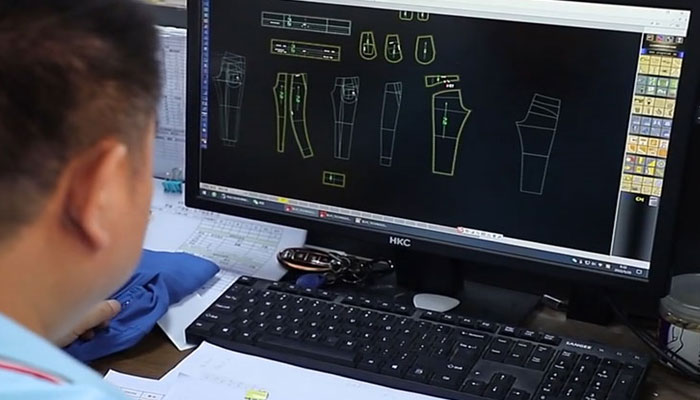
Labour content is estimated from the operations the garment requires and the time allowed for each, and the total is what a factory calls its minutes. The estimate grows with the number of pieces, the number of operations, the difficulty of the fabric and the tolerance the specification demands. It shrinks with line efficiency, which is a function of how well the garment suits the line, how much handling it needs and how often the run stops for a change.
That is why two factories quote differently for the same drawing. One may be pricing a garment it runs every week, with an established method and a line already set up for it; the other may be pricing a garment it would have to develop, with an allowance for a slower first run. Neither quote is wrong, but they describe different levels of experience, and the gap between them is a signal about which factory is in its own category.
Two questions expose the assumptions. How many operations does the garment need, and what time is allowed for the longest one. Where the answer is a total that cannot be broken down, the labour line is an estimate rather than a calculation, and it is the line most likely to change if the specification firms up.
Sampling, pattern and development amortisation
Development costs are one-off and are usually spread across the order quantity, which means the same development is cheaper per unit on a larger run. Pattern making, grading across the size range, sample rounds, and any tooling such as a mould, die or print setup all belong in this line.
Two questions make the line comparable between suppliers. Which of these costs are quoted inside the unit price and which are charged separately, since a lower unit price with separate development charges is not a cheaper supplier, it is a different quotation structure. And which of them recur on a reorder, because a pattern and a grade are one-off while a print setup may be charged again if the screens are not held.
Where a programme expects reorders, the amortisation structure matters more than the first-order price. A supplier that holds the pattern and the screens and charges setup only once is cheaper across a season than one that recharges, and the difference is invisible in a single quotation. The terms that govern that relationship are described in this explanation of factory minimum order quantity.
Printing, embroidery and finishing: quoted per piece or per position
Decoration is priced in one of two ways, and the difference matters as soon as a garment carries more than one mark. A price per piece assumes a single decoration position; a price per position multiplies with every additional mark, so a chest print plus a sleeve print plus a neck label print is three charges rather than one.
Setup sits alongside the per-piece price. Screens, plates, digitising files and any colour-matching are one-off charges, and a design using several colours or requiring an underbase for a light print on a dark garment carries more of them. Whether those setups recur depends on whether the supplier holds the tooling, which is the same question that applies to the pattern.
Finishing such as washing, pressing, bonding or a surface treatment belongs in the same conversation, because it is quoted either per piece or as a separate operation, and it changes both the labour content and the fabric behaviour. Where a decoration is applied, the specification should state the method and the position rather than the appearance, since an appearance-only specification is what allows a substitution from a print to a transfer without a change in the price.
Packaging and labelling costs
Packaging is the line that quietly changes with decisions taken elsewhere. A polybag, a carton, a hangtag and its attachment are each a component with a minimum, and the number of label versions multiplies the minimum rather than sharing it. Where a programme sells into several markets, the language versions of a care label can be the most expensive stationery item in the order.
Two allocation questions keep the line honest. Which packaging components are inside the garment price and which are purchased separately, since a buyer who assumes the bag is included may be buying it twice. And what the standard packing configuration is, because a change to units per carton alters the carton specification and therefore the freight as well as the packaging cost. The documentary requirements that packaging has to satisfy by market are set out in this guide to labels, duties and documentation for wholesale clothing imports.
Where the goods cross a border, the paperwork is a cost line as well as a compliance one, because a consignment held for a query accrues charges while it waits. The procedures customs authorities are expected to maintain are framed by the WTO Trade Facilitation Agreement, and the requirement publications that interpret entry and origin rules for the United States are issued by US Customs and Border Protection.
Margin, currency and payment terms inside the quote
Margin is the least interesting line and the one buyers scrutinise most. What matters more is how the price is exposed to currency, because a quotation in one currency against costs in another carries a risk that either party may have to absorb, and the answer is usually a validity period on the quote. A quote with a short validity is telling you that the exposure is real.
Payment terms are the second part of the same question. A deposit followed by a balance on shipment is the common structure, and the instrument matters as much as the split, because a payment routed through an account that does not match the contracting entity is difficult to recover. The cost of financing the deposit is a real cost of the order and belongs in the landed calculation rather than the unit price.
The third element is the delivery term, which allocates freight, insurance and destination charges between the parties. Two suppliers quoting the same unit price on different terms can differ by more than the price itself, which is why the term belongs at the top of a comparison sheet rather than in a footnote.
Comparing two quotes spec-by-spec instead of on top-line price
The only comparison that means anything is between quotes that describe the same garment, which means the specification has to be fixed before either is requested. Where that has been done, the comparison is mechanical: put the lines side by side, and treat every unstated item as a difference rather than a saving.
| Compare | Why it changes the price |
|---|---|
| Fabric construction, weight and mill | Different material and different wastage allowance |
| Wastage and marker assumption | Consumption per garment moves with the layout |
| Trim list and who specifies it | A substituted component is a different garment |
| Decoration method, positions and setups | Per piece and per position scale differently |
| Development charges and what recurs | One-off and recurring costs behave differently across a season |
| Delivery term and quote validity | Allocations of freight, duty and currency risk |
Where a line is missing from a quote, the correct response is to ask for it rather than to assume it is included. A quotation that omits the wastage assumption, the trim list or the delivery term is not cheaper; it is incomplete, and the missing items reappear later as supplementary charges or as a different garment than the one that was quoted.
Conclusion
A garment price is a specification translated into money, and the seven lines inside it respond to decisions rather than to negotiation. Fabric construction and consumption usually drive the number, labour content follows the operations and the time allowed, development is amortised across the quantity, and packaging and labelling scale with the number of versions. Compare quotes line by line against one fixed specification, ask for whatever is missing, and the gap between two suppliers stops looking like a mystery and starts looking like the difference between two garments.
FAQ
Why are two quotes for the same garment so different?
Because the specifications underneath them differ, usually in fabric construction or wastage, the trim list, the number of decoration positions, and whether development costs are inside the unit price or charged separately. Margin explains far less of the gap than buyers expect.
Which line in a garment price is largest?
Fabric, in most knitwear programmes. It is also the most volatile, because it responds to yarn prices, mill capacity and the dyeing route, and it moves with consumption per garment as well as with the price per metre.
Are development costs charged again on a reorder?
It depends what is held. A pattern and a grade are usually one-off, while a print setup may recur if the screens are not retained. Ask which charges are one-off and which are recharged, because the answer decides the cost across a season.
What is the most important thing to check on a quote?
The delivery term, followed by the fabric specification and the wastage assumption. Without a named term the price is not comparable with another quote, and without the fabric details the price describes a garment that may not be the one you specified.
Next step. If you want a quote you can compare, send the specification as far as it is written. The team can confirm which lines are already fixed, which assumptions a price would rest on, and what a like-for-like comparison would need to include.
