
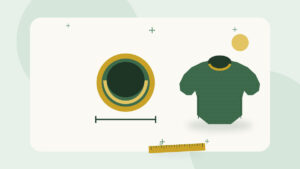
When an undershirt neckband becomes wavy after washing, start by comparing the band, the body neckline and the sewn join. A band can fail to recover, a stable band can be attached to an overstretched opening, or the two fabrics can change dimensions differently in care. Replacing the rib without isolating the cause can leave the defect in the next lot.
Table of Contents
ToggleKeep a new garment and a washed failure side by side
Use samples from the same material lot and size wherever possible. Record whether the opening was already flared before washing, became wavy only after care, or grew after donning. Distinguish general opening growth from a localized ripple at one shoulder or the back join. Check body length and chest width too; broader dimensional change may be contributing to the neck distortion.
Measure each garment flat and relaxed using the same neck-width, front-drop and band-width definitions. Do not stretch the washed garment into the approved shape before measuring. Retain photographs of the starting condition and the result.
Diagnose material, cut length and sewing separately
| Observation | Check first | Useful comparison |
|---|---|---|
| Loose band grows after extension | Band material recovery | New and washed band fabric under the same extension/rest procedure |
| Flat band fabric but distorted finished opening | Attachment feed, seam stretch and band length | Unattached material versus sewn trial on the approved body fabric |
| Distortion only after washing | Band/body dimensional mismatch and seam behavior | Band, body and finished assembly after the same care conditions |
| Some pieces or lines fail, others do not | Cutting consistency and sewing setup | Traceable samples by operator/line and size |
| Broken neck stitches | Seam extension, thread and construction | Donning trial and washed seam inspection |
Specify the band as a separate material
The neck rib may not be the same fabric as the body. Ask for its structure, fibre composition, yarn reference, weight, finished width and recovery requirement. Elastane content alone does not prove that a band will recover satisfactorily. Ask the laboratory to select a stretch/recovery method appropriate to the material and state specimen preparation, extension or force, hold time and rest time.
Test new and washed material. Keep the laundering programme, detergent, drying and cycle count fixed within the comparison. The finished neck assembly also needs assessment: a fabric report cannot show whether sewing has stretched the garment opening.
Control the cut-length convention
Record neckband cut length per size, join allowance and the body neckline length at the attachment seam. State whether allowances are included before calculating any ratio. A ratio calculated from the raw cut edge cannot be compared directly with one calculated from the finished opening.
Make a controlled attachment trial using the actual body and band fabrics. Change one factor at a time, such as band length or feed setup, and compare flatness, donning and washed recovery. An overly short band can pucker or restrict the opening; a longer band may not sit correctly. There is no single ratio suitable for every fabric and neckline.
Use a wash and opening record
| Record field | Entry |
|---|---|
| Identity | Style, size, body lot, band lot and sewing trial reference |
| Initial measurements | Relaxed neck width, front drop, finished band width and visual condition |
| Care conditions | Named procedure, drying, cycles and relaxation before remeasurement |
| Post-care result | Same measurements, waviness, seam damage and band/body mismatch |
| Recovery result | Agreed extension/rest procedure and residual change |
| Disposition | Accept, revise material, revise pattern ratio or revise attachment process |
Set limits from the approved fit and washed reference rather than from an arbitrary percentage. For V-necks, include point construction and symmetry using the V-neck measurement guide. General structure choices are discussed in the existing tee neckband troubleshooting article; keep the undershirt review focused on repeated donning, care and the intended outer layer.
Carry the correction into production
Approve a washed garment with the corrected band and sewing setup. Update the band reference, cut-length table, joining method and stitch specification together. Check first pieces of relevant sizes before the run continues, and retain garments from each lot. If complaints recur, compare retained pieces using the same care and measurement record instead of assuming the original cause has returned.
Send the failed and approved references, lot details and trial results through Knitwear Base when requesting a corrective sample. Confirm material and construction feasibility before assigning a new bulk acceptance standard.
