
Gym wear is bought by three very different customers through the same product description. A gym chain wants a stocked core it can reorder; a team wants squad quantities with personalisation; a brand wants a range it can sell on its own terms. Each of those programmes specifies the same garment differently, and the differences show up in the fit, the decoration workflow and the size ratio rather than in the styling.
Custom Gym Wear Manufacturer: what to confirm before you send a tech pack
The brief should state the customer type and the training intensity before the styling, because those two answers determine the fabric weight, the seam type and the fit. It should then fix the fabric and its recovery expectation, the seam type at each join, the size range, and the decoration method. Two items carry more weight in this category than in most: the print, because it is applied to a fabric that will be stretched and washed frequently, and the armhole and shoulder construction, which decide whether the garment restricts movement.
Two further items belong in the brief. The intended fit, since a training garment worn close and one worn loose carry different requirements. And the fabric’s moisture behaviour, because it is described in the same words on every specification sheet and verified by a test rather than by the description. The fabric options for this balance are compared in this guide to fabrics selected for sweat, stretch and recovery.
MOQ structure for knit gym wear: how minimums work per style, colour and size
Minimums in this category are shaped by the fabric and by the decoration. Performance knits with a spandex content are stocked in fewer weights and colours than basic jersey, so a colour outside the range may require a produced lot. On the decoration side, a screen print carries a setup per colour per position, and a multi-colour mark on a small order spreads that cost across very few units.
Buyers should ask the minimum per colour, the minimum per size, and how the decoration setup is structured — per order or per run. That last answer changes the economics of a first test order, because a setup charged per order makes the reorder materially cheaper per unit. The garment-side thresholds are explained in this guide to clothing factory MOQ for wholesale buyers.
How the minimum changes when a new colour or fabric enters a knit gym wear programme
A new colour is a dye lot with its own minimum and lead time, and on a light-to-mid performance knit the threshold is frequently driven by the fibre rather than the garment. Where the print runs across a dark garment an underbase may be required, which adds a screen and therefore a further setup, so a colour change is often a decoration change as well.
A new fabric changes the fit, the seams and the print. A heavier knit alters how the garment behaves at the armhole, a fabric with different recovery changes whether the print survives extension, and the care instruction changes with the blend. Where the weight or the composition changes, the seam and decoration specifications should be reviewed together rather than carried over.
Sampling sequence for knit gym wear: what the fit sample and the PP sample each lock
The fit sample locks the block and the movement: measurements at the base size and the extremes, armhole and shoulder behaviour, and how the garment feels through the intended activity. It should be evaluated in motion, because a training garment can measure correctly and still restrict. The pre-production sample then locks the fabric, the seams, the decoration, the trims and the labels that bulk will use, and it should carry the real decoration rather than a stand-in.
Both approvals should be documented against references and retained, with the fabric recorded by composition and weight and the decoration placement given with a tolerance. The documentation practice is described in this sample approval protocol for wholesale orders.
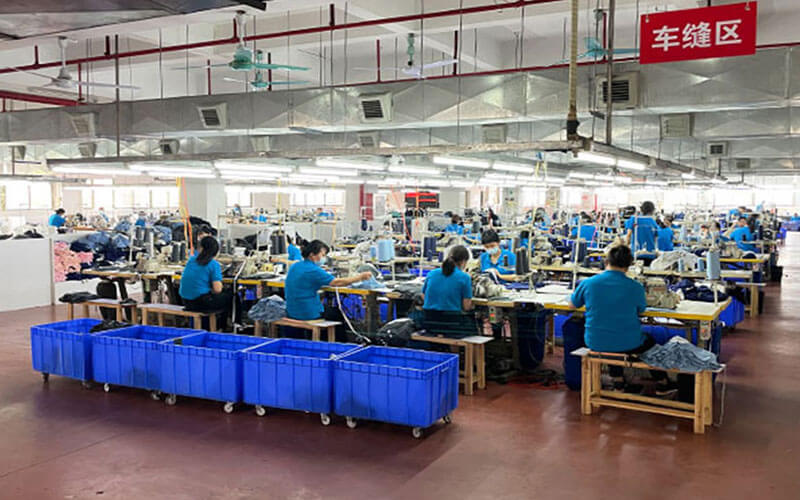
Decoration and branding on knit gym wear: print, embroidery, labels, hangtags and packaging
Decoration on gym wear has to survive two things at once: washing and stretching. A print that cracks when the fabric extends is a specification failure, and the way to avoid it is to test the method on the production fabric under extension rather than approving it from a flat sample. Where names or numbers are applied to individual garments, the workflow should include a per-garment check, because a mix-up is not correctable after delivery.
Placement should be specified from a named reference with a tolerance and measured with the garment relaxed, since a position specified under tension shifts in wear. Where embroidery is used, the backing has to suit the fabric and the digitised file should belong to the brand. Component and test references worth naming include OEKO-TEX Standard 100 for harmful-substance testing, the ASTM standards programme for textiles for the physical tests and amfori for the BSCI social audit framework.
QC checkpoints that decide whether a knit gym wear bulk order ships clean
Inspection should concentrate on what fails in use. Fabric recovery after repeated stretching, seam integrity under load, armhole and shoulder construction, measurements at the base size and the extremes, and colour consistency against the approved standard. On the decoration: placement, coverage and durability after the stated care regime. Where personalisation is applied, each garment should be verified against its own instruction rather than sampled.
The print and seam checks carry the most risk, because both are functional properties that fail after the garment has been worn. The first-off garment should be verified before the run continues, including an extension test at the seams and across the print. Testing houses publish the scope they apply, as Intertek’s textiles and apparel testing range illustrates, and the ICC Incoterms rules settle where cost and risk transfer on delivery.
The order of checks matters, because a decoration error is the most expensive to correct. The first-off garment should be confirmed for placement and coverage before the run continues, and the wash and extension tests should be run on the pre-production sample rather than on the finished batch, where there is no room left to change the method or the fabric.
How do I make my own gym clothing brand?
Decide the customer type before the garment.
A gym, a team and a retail brand buy the same category differently, so the customer type determines the fit, the ratio, the decoration workflow and the reorder pattern.
A gym chain buys a stocked core it can reorder and personalise lightly. A team buys squad quantities with individual names or numbers. A retail brand buys to a size curve for a season and is judged on sell-through. Each of those leads to a different specification for what looks like the same garment, and starting from the design usually means discovering the mismatch during sampling.
Once the customer type is fixed, the brand needs a measurement set with tolerances, a construction specification covering the seams and the armhole, the fabric specification including recovery, and the decoration and branding assets. Those four documents are what every later order depends on, which is why they are worth building on the first run. Development scope across those stages is described in this overview of sportswear manufacturing.
How much does it cost to start a fitness clothing brand?
The cost is development plus a first order.
Starting a fitness range means paying for pattern and grading, sample rounds, decoration setup and a first order, with the fabric weight and the decoration method being the two largest variables.
The development element covers the pattern, the grade and the sample rounds, and it is incurred once. The fabric element scales with the weight and the fibre, and performance knits cost more than basic ones. Decoration carries a setup per colour per position and a running cost per piece. The first order then carries the minimum quantities of the fabric, the garment and any made-to-order component.
Two structuring choices reduce the entry cost without reducing quality. Launching on a stocked fabric in a single colourway avoids a dye lot minimum, and starting with a single-position decoration keeps the setup to a minimum. What should not be reduced is the specification work, because the pattern, the grade and the fabric reference are the assets that make the second order cheaper than the first.
A further consideration is the size range at launch. A narrow range concentrated on the sizes the channel actually sells is cheaper to produce and faster to sell through, and additional sizes can be added once the fit has been validated. Launching across a wide grade divides a modest quantity into very small quantities per size, which raises the cost per unit and slows the read on demand.
Conclusion
Gym wear is one category serving three customers, and the specification follows the customer rather than the garment. The training intensity sets the fit and the seam, the customer type sets the ratio and the decoration workflow, and the fabric recovery decides whether the garment still performs after a season. Decoration has to survive stretching as well as washing, which is why it is tested under extension. Buyers who fix the customer type and the fit first, test the print and the seams on the production fabric, and keep the pattern and the fabric reference together get a range that holds up in use.
FAQ
Why does the print crack on some gym wear?
Usually because the method was chosen or tested on a flat sample rather than on the fabric under extension. A performance knit stretches in wear, and a print that cannot extend with it will crack. The test should be run on the production fabric under stretch.
How does a team order differ from a retail order?
A team order follows squad quantities and usually carries personalisation on individual garments, so the decoration workflow includes a per-garment check. A retail order follows a size curve and reorders on sell-through rather than when a squad changes.
What is the cheapest way to test a gym wear style?
Use a stocked fabric in one colourway with a single-position decoration and a narrow size range. That combination avoids the three costs that scale badly at low volume while still producing a pattern and specification you can reuse on the reorder.
Does the armhole affect how a training garment performs?
It does. An armhole that does not move with the chest measurement restricts movement even when the garment measures correctly, which is why the block should be evaluated in the intended activity rather than on a flat table.
Next step. If you are developing a gym wear range, send the customer type, the training intensity and the decoration you are considering. The team can confirm how the fit and the seams would be specified, which decoration method suits the fabric, and where the minimums sit.
