
Custom loungewear is where a brand creates assets rather than garments. A set needs two patterns, two graded size runs and a confirmed relationship between them, and the work is paid for once and reused for years. The commercial questions — who holds the pattern, who owns the tooling, what the sample fee covers — are therefore more important here than the unit price, because they determine whether the brand can ever move the product.
Custom Loungewear Manufacturer: what to confirm before you send a tech pack
The brief should state the set composition and the fit intent before anything else. Which pieces make up the set, whether the top and bottom are cut as a matched pair or as independent pieces, and what the intended body is. A set programme doubles the pattern work, so the decision to develop a new block has twice the consequence it has on a single garment, and it should be taken deliberately rather than discovered during sampling.
Two further items belong in the brief at this stage. The size range the set has to cover, because grading two garments across a wide range multiplies the risk of a mismatch at the extremes. And the material specification for each piece, since a set built from two fabrics carries two consumption calculations and two care labels.
What to verify on a loungewear factory before committing to a knit first order
Verification should test the category rather than the size of the business. A factory that runs knit loungewear routinely will have the machinery for both a top and a bottom, the rib and elastic relationships a set needs, and finishing routines that suit a garment worn against the skin. One that treats loungewear as an addition to a different category may subcontract the parts it does not run, which adds calendars the buyer cannot see.
Three pieces of evidence shorten the exercise. A comparable specification and a physical sample from a set the factory has produced. A business licence confirming the entity being contracted. And a written statement of which processes run on site and which are bought in, since dyeing, specialised printing and some elastic production are commonly external. Buyers should ask all three before the first order rather than after the first delay.
One further question is specific to a set programme and worth asking early: whether the top and the bottom are cut and sewn in the same building. If they are produced separately, the pairing between them is being managed across two sites, and the risk of a shade or measurement mismatch rises accordingly. A factory that runs both halves under one roof can control the pairing as part of its own quality process rather than as a coordination exercise.
How size grading and size-ratio planning change a knit loungewear order
Grading a set requires two grades that stay related, and the ratio then decides how the two are bought. Because a set is usually sold in one size, the ratio is expressed in sets, and the top-to-bottom pairing is fixed by the grade rather than chosen at the packing stage. That makes the grade a commercial decision as much as a technical one.
The practical control is to state the correspondence explicitly: for each size of top, the measurement of the matching bottom. Where a brand also sells pieces separately, the ratio becomes a planning decision, because the bottoms and tops will not sell in equal numbers and the excess of one becomes stock. Buyers should decide whether the range is set-led or piece-led before the first order, since that decision determines both the cutting ratio and the packaging. The pack consequences are covered in this guide to pajama sizing and ratio planning.
What happens to the pattern and tooling if a knit loungewear programme changes supplier
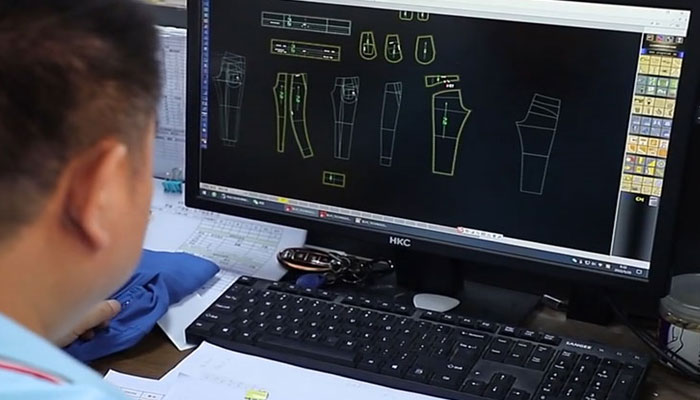
The answer depends on what was agreed when the pattern was created, and in a set programme the exposure is doubled because two patterns are involved. If the patterns stay with the factory, a new supplier has to reverse-engineer both fits from physical samples, which rarely reproduces the original and always costs sample rounds. If the brand holds the digital patterns, the graded sets and the measurement specifications, the change becomes a sampling exercise.
A workable structure separates the reusable block from the specific pattern: the factory keeps the block it uses across its own work and releases the specific patterns and grading for the styles the brand paid to develop. Buyers should name the file formats, the deliverable list and the payment trigger in the agreement, and should treat file transfer as a deliverable of development rather than a favour requested later. The measurement tolerances matter as much as the measurements, because a chart without its allowances cannot be reproduced.
Tooling follows the same logic. Any component made specifically for the programme, whether a branded elastic, a printed label plate or a moulded part, is an asset with an owner, and the position should be recorded at the outset rather than reconstructed if the relationship changes. Buyers should also establish what happens to a physical pattern if a digital file is unavailable, because re-digitising a pattern is a cost somebody has to bear and it is easier to agree before it is needed.
Payment, deposit and sample-fee terms worth agreeing early on knit loungewear
A set programme carries fixed costs that behave differently from garment costs. Two patterns and two grades are incurred once. Sample fees may or may not be credited against a first order. Any tooling, such as a branded component, is paid for once and belongs to somebody. A deposit structure that treats all of this as one line makes later changes hard to price.
The terms worth fixing early are the ones that prevent re-quotation: what the sample fee covers and whether it is credited, whether pattern work is charged separately, who owns the patterns and any tooling, and how a change to the brief is priced after approval. Buyers should also confirm the currency and who carries the exchange risk, because a deposit-heavy structure costs cash earlier. The ICC Incoterms rules settle where cost and risk transfer on delivery, which is a separate question from when the deposit falls due.
How to write a knit loungewear specification the factory cannot misinterpret
A specification fails when a term can be read two ways. “Relaxed fit” and “soft waistband” are intentions rather than instructions. A waistband needs a type, a width, an elasticity expectation and an attachment method. A neckline needs a finish and a recovery expectation. Measurements need a base size, a tolerance and a direction for the grade, and in a set they also need the correspondence between the two pieces stated explicitly.
Buyers should also name the tests that will settle a disagreement. For the material, OEKO-TEX Standard 100 is the common apparel baseline for harmful-substance testing, and the ASTM standards programme for textiles provides neutral vocabulary for describing the property under test. Where a fibre claim is certified, GOTS documents organic content. Testing houses publish the scope they apply to garments, as Intertek’s textiles and apparel testing range illustrates.
The specification should also state what the brand will do with a deviation once it is found. A tolerance is only useful if there is an agreed consequence for exceeding it, whether that is rework, replacement or acceptance with a recorded note. Programmes that write tolerances without agreeing the consequence tend to resolve the question commercially, at the point where the goods are already made and the buyer has the least leverage.
Where can I find a supplier of loungewear?
Where the set capability already exists.
Look for a manufacturer that runs both a top and a bottom in knit fabrics, since a supplier that produces only one half of the set will have to buy in the other.
The category test is specific in this case: a loungewear set needs a factory that can cut and sew both garments, handle the rib and elastic on the bottom, and finish a neckline that will be worn against the skin. A supplier that produces only tops will subcontract the bottoms, which splits the specification across two sites and makes the pairing check harder to enforce.
The second question is about grading capacity. Grading two garments and keeping them related is more demanding than grading one, so buyers should ask to see the measurements of a set the factory has produced at both the smallest and largest sizes rather than at the centre. Knitwear Base’s loungewear programme covers the category from development through packing, and the same questions should be applied to any supplier being compared.
How much does it cost to get a clothing manufacturer?
The cost is in the elements, not the relationship.
There is no headline price for a manufacturing partner; the cost is development, fabric, make, trims and decoration, each responding to a different decision.
Development on a set covers two patterns, two graded runs and the sample rounds needed to confirm both, which is the largest single difference between a set programme and a single-garment one. Fabric scales with the number of pieces and with weight. Make reflects the operations in each garment. Trims cover rib, elastic, labels and packaging, each potentially with its own minimum. Decoration carries a setup and a running element.
Buyers comparing offers should therefore compare element by element against one specification and one delivery term rather than comparing totals. A quotation that appears lower may exclude pattern ownership or carry a lighter fabric; one that appears higher may include components the other leaves to the buyer. Writing the comparison as a table of elements is what makes the difference visible, and the development scope that sits behind it is described in this overview of apparel design and development.
Conclusion
Custom loungewear is a development project with two patterns, two grades and a relationship between them, and the commercial terms decide whether those assets stay with the brand. The specification has to pin down the waistband, the neckline and the correspondence between the pieces, because those are the elements that determine whether the set is comfortable and whether it reads as one product. Buyers who fix the pattern ownership, the sample-fee terms and the measurement tolerances before the first order get a product they can reproduce and move; buyers who negotiate only the unit price get a set they cannot leave.
FAQ
Does a custom loungewear set need two patterns?
Yes, one for the top and one for the bottom, plus two graded size runs. The patterns also have to be developed with the relationship between the pieces in mind, so the waist of the bottom corresponds to the size of the top across the whole range.
Who should own the patterns for a custom set?
The commercial answer is negotiable, but the practical answer is that a brand which does not hold them cannot move the style without re-developing both fits. A workable structure releases the specific patterns and grading on payment of a stated fee while the factory keeps its reusable block.
What should the sample fee cover on a set programme?
It should be clear whether the fee covers both garments or one, what number of rounds are included, and whether it is credited against a first bulk order. Because a set involves two patterns, the sample cost is higher than on a single garment and the terms matter more.
How do we compare two manufacturing quotations for a set?
Freeze one specification and one delivery term, then compare development, fabric, make, trims and decoration as separate elements. Comparing totals hides whether a quotation includes both patterns, both fabrics or the same components.
Next step. If you are developing a loungewear set, send the pieces, the size range and the fabrics you have in mind. The team can confirm the development scope, how the two patterns would be graded together, and which commercial terms carry forward to later orders.
