
Manufacturing clothing in China is not a single decision, it is a sequence of about eight stages, and each one produces the input the next requires. Most delays that buyers attribute to production are caused by inputs that were not ready when the stage needed them: a measurement set that was never confirmed, artwork that arrived after the labels were printed, a fabric booking that started after the sample was approved. Understanding the sequence is what allows a buyer to see where their own decisions sit on the critical path.
How to Manufacture Clothing in China: what a buyer has to settle first
Four inputs are needed before a factory can quote or plan. The specification, which describes the garment, the construction and the materials. The quantity and the size range, which determine whether the minimums are met. The delivery window and the destination, which determine the packing and the freight route. And the approvals the buyer will owe, because those sit on the factory’s calendar just as firmly as the factory’s own milestones.
The most useful preparation is to schedule the buyer’s own decisions rather than only the factory’s. A programme that lists its fabric confirmation date, its artwork approval date and its sample approval date has a plan; one that waits for the factory to ask has a schedule it does not control.
Two further items shorten the sequence before it starts. The market the goods are sold into, because labelling and documentation requirements differ between destinations and the seller of the finished goods carries the obligation. And the packing specification, because a fold standard that is decided after production changes the carton count and therefore the freight. Both are cheap to settle at the beginning and expensive to change at the end.
The sourcing sequence for first production: brief, shortlist, sample, approve, bulk, ship
The sequence runs from brief to shortlist to sample to approval to bulk to shipment, and each transition has a condition. The brief produces a specification complete enough to quote. The shortlist produces candidates that run the category. Sampling produces a physical standard. Approval converts the sample into a written specification with tolerances. Bulk runs against that specification. Shipment follows the delivery term agreed at quotation.
Four conditions cause most of the delay. A specification that leaves the fabric weight implied rather than stated, so the factory quotes a range instead of a price. A sample approved by email with no record of what changed, so the bulk standard is a memory. A fabric booking started after the pre-production approval, which puts the longest external dependency in the middle of the calendar. And an approval date that was never agreed, so the buyer does not know what they owe and the factory does not know when to expect it.
| Stage | What closes it | Document it produces |
|---|---|---|
| Brief | A specification the factory can cost from | Tech pack and measurement table |
| Shortlist | Capability, minimum and production site verified | Supplier comparison sheet |
| Sample | An approval against a physical reference | Approved sample plus a versioned specification |
| Bulk | Materials confirmed and a production window agreed | Order confirmation with dates |
| Ship | Inspection passed and documents complete | Inspection report and shipping documents |
Read down the third column and the shape of the whole process becomes visible: each stage exists to produce the document the next one depends on. That is why compressing the sequence by skipping a stage does not save time, it moves the work later, when correcting it costs more and the buyer has less leverage.
How to shortlist candidates when you are sourcing first production
For first production the filter is capability against the specific garment rather than size or reputation. A supplier that runs the category routinely will have the machinery, the material relationships and the finishing routines in place. One that treats the category as an addition may subcontract the parts it does not run, which adds calendars the buyer cannot see.
Three questions establish more than a catalogue does. Which category is run routinely, and at what weights? Which processes are performed on site, and which are bought in? And what does the factory need in writing before it will start cutting? The third answer describes the programme’s real prerequisites, which is more useful than a service list.
A fourth question is worth asking of any supplier that survives the first three: what capacity is available during the weeks the order would actually run? Capacity in general says little, because a factory can be capable and fully booked at the same time. Seasonality affects this more than most buyers expect, and knowing the window in advance is what allows the production start to be scheduled against a real date rather than an assumption.
Questions to ask before you share designs or tech packs for first production
Three questions belong before the files are sent. Who will see the design inside the factory, and how is it stored? What happens to the pattern and the artwork at the end of the relationship? And if the design is confidential, what will the factory commit to in writing? None of those is difficult to answer, but all of them are easier to ask before the conversation has invested time on both sides.
The practical arrangement is to send what is necessary and record what was sent. A specification can describe the garment without handing over the whole design, and a written record of what was shared and when is what settles a later disagreement about originality. Where the brand intends to own the pattern, the position should be recorded before the first sample rather than requested after the first order.
What a small first order for first production really costs, and how to plan it
The cost divides into development, material, make, decoration and components, and each behaves differently. Development is fixed and incurred once. Material scales with the weight and may carry a dye lot minimum. Make scales with quantity and complexity. Decoration carries a setup and a running element. Components are made to order in minimum quantities that can exceed the garment order.
Two planning points follow. The first order will be more expensive per unit than the second, not because the factory is overcharging but because the fixed elements are spread across fewer units. And the cheapest way to test a style is usually a stocked material in a narrow palette with a simple decoration, because those three choices avoid the costs that scale badly at low volume.
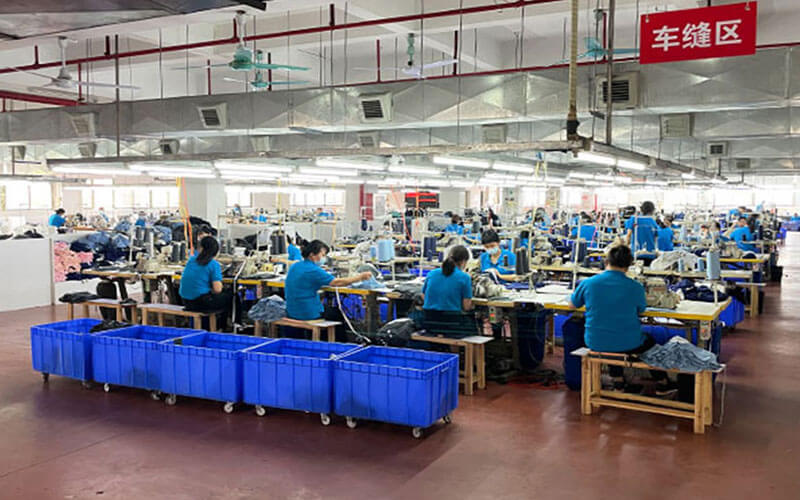
Normalising quotations so two suppliers for first production can be compared fairly
Quotations differ for a small number of reasons, and labour rate is rarely one of them. The differences are in what is included: pattern and grading, the fabric minimum, decoration setup, packing specification and delivery terms. Normalising means freezing the specification and the delivery term and then marking every scope item as included, excluded or separately priced.
The delivery term is the item most often left implicit, and it is the one that makes two prices incomparable. The ICC Incoterms rules define where cost and risk transfer between buyer and seller, so a price quoted without a named term cannot be placed alongside another. What remains after the two freezes is the genuine difference between suppliers.
QC and inspection arrangements for a first production order
Three arrangements make a first order controllable. An approved pre-production sample retained by both parties. A first-off check before the run continues, since pattern and placement errors repeat across the order. And a final inspection against the measurement specification with stated tolerances.
Two references make those checks comparable between suppliers. The ASTM standards programme for textiles supplies neutral vocabulary for the property being tested, and testing houses publish the scope they apply to garments, as Intertek’s textiles and apparel testing range illustrates. Where the programme also carries a labour or material requirement, amfori administers the BSCI social audit framework and Textile Exchange covers recycled and preferred fibre claims, each documented separately from the quality inspection.
The order of the checks matters as much as their content. Decoration errors are the most expensive to correct, so the first-off garment should be confirmed for placement and coverage before the run continues. Dimensional errors are the next, and they should be caught in-line where the setting can still be changed rather than at final inspection, where the only remaining option is to classify the fault.

Can I buy clothes directly from the manufacturer?
Yes, and that is the normal B2B route.
Buying directly from a factory is standard for brands and wholesalers; what changes between suppliers is the minimum quantity, the component structure and whether the factory sells to end consumers as well.
Most apparel manufacturing is factory-direct by design: the brand or distributor contracts with the manufacturer, and the factory does not sell the garment to consumers. Where a factory also runs a consumer-facing business, the point to establish is whether the same construction is sold under its own label, because that affects exclusivity rather than the ability to order.
The practical questions are the ones that apply to any direct relationship: the minimum per colour and per size, which processes are on site, the component minimums, and the delivery term. Buyers moving from a trading company to a direct factory conversation often find the minimums higher and the prices lower, which is the same trade-off described from the other side. Development scope across the sequence is described in this overview of apparel design and development.
Conclusion
Manufacturing clothing in China is a sequence in which every stage depends on an input from the one before it, and most delays are caused by inputs rather than by capacity. The specification, the quantity, the delivery window and the buyer’s own approval dates are the four things to settle first, because they determine whether the rest of the calendar can hold. Buyers who schedule their own decisions, freeze the specification and delivery term before comparing quotations, and put the three quality arrangements in place before cutting starts get an order that runs to its plan.
FAQ
How long does clothing production take in China?
The sewing stage is the shortest part of the timeline. Sampling, material booking and the buyer’s own approvals usually account for more of the elapsed time, which is why programmes that book material early and schedule approvals finish sooner than programmes that compress the sample rounds.
What has to be in writing before cutting starts?
An approved pre-production sample held by both parties, a measurement specification with tolerances, a confirmed material and trim list, the decoration placement reference, and the packing specification. Anything still open at cutting becomes a change order later.
Should we buy through a trading company or directly from a factory?
A trading company can be useful for mixed orders and small quantities; a factory is the right route once the specification must be held across orders. The questions are the same either way, but the answers reveal which one you are dealing with.
What is the most common cause of delay on a first order?
An incomplete specification that forces the factory to quote a range rather than a price, followed by a late material booking. Both push the longest external dependency onto the critical path, where the calendar has no room left to absorb it.
Next step. If you are planning a first production order, send the specification you have and the dates you are working to. The team can confirm what is already defined, which stages can run in parallel for your construction, and which decisions the calendar depends on.
