
Private label orders rarely fail in the sewing room; they fail in the artwork folder. A programme goes into production with a care label that was approved late, a hangtag whose barcode was added after the cartons were printed, or a fibre composition line that does not match the fabric actually delivered. Each of those is a small administrative gap that becomes a large commercial one, because the goods cannot be sold until it is closed. Treating private label as a compliance and approval exercise, rather than as a branding exercise, is what keeps the calendar intact.
What does private label actually transfer to you?
The identity of the goods, not the design.
Private label puts your brand on the product, its labels and its packaging; it does not by itself transfer the design, the pattern or the exclusivity of the style.
Buyers often use “private label” and “own design” interchangeably, and the two are different commitments. Private label describes who the product is sold as: the brand, the label, the care information and the packaging carry the buyer’s identity rather than the factory’s. Whether the design underneath is the buyer’s own or drawn from the factory’s range is a separate question that has to be answered in the agreement.
Separating the two matters because they carry different costs and different risks. Branding assets are the buyer’s and are usually inexpensive to change. The design, the pattern and the fit block may belong to the factory, in which case the brand’s private label exists on top of a style the factory can also offer to other buyers. A private label programme can therefore be either a light branding layer on a catalogue style or a fully owned product, and the quotation should say which one is being bought.
What you own and what the factory owns in a private label programme
The clean way to draw the line is to list the assets and assign each one. Assets the brand normally owns are the trademark, the label artwork, the care and composition text, the hangtag design, the packaging print, the photography and any barcode or retail identifier issued to the brand. Assets the factory normally holds are the pattern, the graded set, the fit block, the marker and the measurement specification, unless the brand has paid for a transfer.
The boundary that causes the most trouble is the artwork applied to the garment itself. A print or embroidery design may be commissioned by the brand but digitised, adjusted and stored by the factory. Buyers should ask where the production-ready artwork file lives and in what format, because a brand that cannot obtain its own print file is dependent on one supplier for every future reorder of a product it believes it owns.
The private label asset list: labels, care labels, hangtags and packaging
A private label programme usually needs six physical components, and each has its own production method, minimum and lead time. Treating them as one item called “labels” is the most common cause of late artwork, because woven labels, printed labels, care labels and hangtags are produced by different processes with different setup requirements.
| Component | Typical production route | What delays it |
|---|---|---|
| Brand label (neck or side) | Woven or printed | Artwork finalisation and loom setup |
| Care and composition label | Printed | Fibre and care text not yet confirmed |
| Hangtag | Printed card, often with variable data | Barcode or price format supplied late |
| Polybag or inner wrap | Printed film or plain | Destination-market packaging requirements |
| Carton and carton mark | Printed or labelled | Piece count and shipping marks not fixed |
| Security or retail identifier | Applied by the supplier or the brand | Third-party system access and data format |
Sourcing these components is a supply chain in its own right. Buyers should ask which of them the supplier sources and which the brand is expected to supply, and whether the supplier holds stock of the standard items or orders them per programme.

Approval workflow: who signs off artwork, and when
Artwork approval should be sequenced so that each approval happens before the step it gates. Composition and care text come first, because they determine the printed care label. Brand label artwork comes next, because label production needs the final file. Hangtag and packaging artwork follow, since they carry variable data that depends on the retail route. Print and embroidery artwork is approved alongside the pre-production sample, so the sample carries the real decoration rather than a stand-in.
Two rules keep the sequence honest. Every approval is recorded in writing against a reference number, so a later dispute can be settled by comparing the approved version with the delivered one. And every approval has a named approver on the brand side, because an approval given by three people in a group thread is an approval that can be disputed later by all three. Suppliers should be able to state the latest date by which each approval must arrive for the production plan to hold.
Lead times for labels and packaging that gate production
Label and packaging lead times gate the packing stage rather than the sewing stage, which makes them easy to underestimate. A programme can finish every garment on schedule and still miss its shipping window because the hangtags arrived after the cartons were packed, forcing the goods to be reopened. The length of the gate depends on the component: standard woven labels and plain polybags are usually available from stock, while printed film, custom cartons and variable-data hangtags are made to order.
The practical control is to treat the label and packaging track as a second critical path running alongside production, with its own dates. Buyers should ask for the supplier’s standard lead time for each component, decide early which items will be standard and which will be customised, and place the label order at the point the artwork is approved rather than when production finishes.
How private label changes minimums compared with stock programmes
Custom components set the real minimum.
A stock programme’s minimum is set by the garment; a private label programme can be pushed higher by the minimums of its woven labels, printed film, cartons or hangtags, whichever is largest.
This is the most frequently missed commercial consequence of private labelling. A brand may be able to order garments in a small quantity and still be unable to order the packaging in the same quantity, because a woven label loom or a printed film run has its own entry point. The programme minimum is therefore the largest of the component minimums, not the garment minimum.
Buyers have three ways to manage it. Use standard components where the brand can accept them. Keep a single label and packaging specification across several styles so one component order covers the whole range. Or accept a stock of components that carries into the next programme, and accept the storage and obsolescence risk that comes with it. Each is a legitimate trade-off, but it has to be chosen deliberately rather than discovered at the artwork stage.
Compliance text on private label: fibre, care and origin
The text on a private label is regulated in most destination markets, and the obligations sit with the seller of the finished goods rather than with the factory. Three categories of information are usually required: the fibre composition, the care instructions, and the country of origin. How each is expressed, in what language, and in what order differs by market, so the label cannot be designed once and reused everywhere without checking.
For the United States, the Federal Trade Commission publishes business guidance on textile and apparel labelling obligations, including the rules on fibre content and care instructions, through its business guidance resource centre. For the European Union, the European Commission’s textiles and clothing framework sets out the fibre naming and labelling regime that applies to textile products placed on that market. For imports into the United States, the country of origin marking requirements are administered by Customs and Border Protection, which publishes them in its informed compliance publications.
Two further points are worth carrying into the label brief. Where a fibre claim is certified, the claim has to travel with a documented chain of custody rather than a statement from the supplier; GOTS and Textile Exchange’s standards programme are the frameworks most often referenced for organic and preferred-fibre claims. And where the material itself is tested, OEKO-TEX Standard 100 is the common apparel baseline.
This section summarises the frameworks and is not a substitute for market-specific legal review; confirm the final label text with a compliance adviser for each destination market.
Where private label programmes fail: artwork rework and label mismatch
Failures are almost always version-control failures rather than production failures. The composition text is updated after the care labels are printed. The brand logo is redrawn and the woven labels are already on the loom. The hangtag carries an old country of origin. In each case the physical goods exist before the document that governs them is final, and the correction costs more than the original component because it happens after packing.
The remedy is a single controlled version of each asset. One file per component, one version number, one approver, and a rule that no component is ordered until its artwork version is locked. Programmes that run this discipline rarely experience rework, and when they do it is contained to a single component rather than to a whole shipment.
A private label readiness checklist
Before a private label order is placed, the brand should be able to answer each of the following without referring to anyone else. Any item that cannot be answered is a gate that has not yet closed, and gates that close late are the ones that move shipping dates.
- Trademark and brand name confirmed as usable in the destination market
- Fibre composition text finalised and consistent with the specified fabric
- Care instructions finalised for the fibre, the construction and the market
- Country of origin text confirmed for the production site and the market
- Brand label artwork locked, with the file format the label maker requires
- Hangtag artwork locked, including any barcode or variable data
- Packaging specification locked, including polybag and carton requirements
- Named approver for each component, and a recorded approval reference
- Component minimums checked against the garment minimum
- Label and packaging order dates scheduled against the production plan
How do you move a stock style into a private label programme?
Add branding assets to an existing garment specification.
Take a style the supplier already produces, confirm its fibre and construction, then apply your own labels, care text and packaging to that specification without changing the garment.
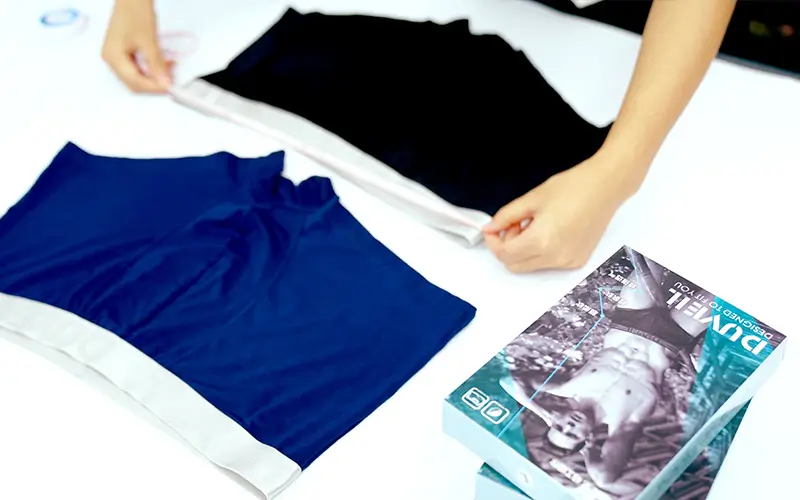
The conversion is deliberately light. Because the garment itself does not change, no new pattern or fit approval is needed, and the sampling requirement reduces to confirming that the brand’s labels and packaging sit correctly on the finished item. The work is concentrated in the assets: composition and care text that match the actual fabric, a brand label position agreed with the supplier, and a packaging standard that suits the retail route.
Two decisions determine whether the conversion stays light. If the brand wants a change to the garment as well — a different fabric, weight or fit — the programme becomes a development project rather than a branding one. And if the brand wants the style to be unavailable to other buyers, that is an exclusivity negotiation rather than a private label step.
Conclusion
Private label is the branding and compliance layer of an apparel programme, and its risks are administrative rather than technical. The order transfers the identity of the goods to the brand, not the design underneath, so the design and pattern position has to be settled separately. Six physical components — brand label, care label, hangtag, inner packaging, carton and any retail identifier — each have their own minimum and lead time, and the programme’s entry quantity is set by the largest of them. Text on those components is regulated by the destination market and the obligation sits with the seller, which is why composition, care and origin text should be locked before any component is ordered. Brands that control one version of each asset and sequence the approvals correctly get a private label programme that runs to the production calendar rather than to the artwork calendar.
Next step. If you are building a private label programme, send the label, care and packaging components you plan to use. The team can confirm which ones can be sourced with the order, which the brand should supply, and where the component minimums sit relative to the garment minimum.
FAQ
Does private label give us the exclusive rights to a style?
No. Private label governs how the product is branded and sold, not who may produce or sell the style. Exclusivity is a separate commercial term, usually tied to volume or term, and it has to be negotiated and recorded in the supply agreement.
Can we use the same label artwork in the US and the EU?
Often not without changes. Fibre naming, care symbol conventions, language requirements and origin marking differ between markets. The safest approach is to design a label template per market and confirm the final text with a compliance adviser before the label order is placed.
What usually delays a private label order?
Late artwork and late composition text. Label, hangtag and packaging components are made to order and carry their own lead times, so an approval that arrives after production finishes forces the goods to be reopened for packing rather than simply delayed.
Who is responsible for the accuracy of the care and composition text?
The obligation sits with the seller of the finished goods, which is normally the brand. The supplier provides the fabric and construction information the text depends on, but the brand should verify that the final label matches the material actually specified and delivered.
