
Underwear is one of the few apparel categories where a millimetre of waistband tolerance decides whether a customer reorders. The garment is small, worn against the skin, washed constantly and judged almost entirely on comfort, which means the specifications that matter are construction details rather than visual ones. Buyers choosing a manufacturer in China should verify capability on those details before a sample is cut, because a sample that fits but uses the wrong elastic has answered the wrong question.
Underwear Manufacturer China: what to confirm before you send a tech pack
The pack an underwear programme needs is narrower than a general apparel pack and deeper in one area: the elastic and the seams. Before sampling, the brief should fix the waistband type and width, the leg-opening finish, the seam type used at each join, the fabric composition family, and the measurement set with tolerances. It should also state the intended wearer and market, because the same style is cut differently for a European and a North American size range.
Buyers should also decide which parts of the garment are fixed and which may vary. A factory is often given latitude on internal construction, which is efficient until the delivered goods differ from the approved sample in a way nobody specified. Naming the fixed elements — waistband, leg finish, seam type at the front rise — removes that ambiguity without dictating every operation.
Waistband, pouch and leg-opening construction on knit underwear programmes: where comfort complaints start
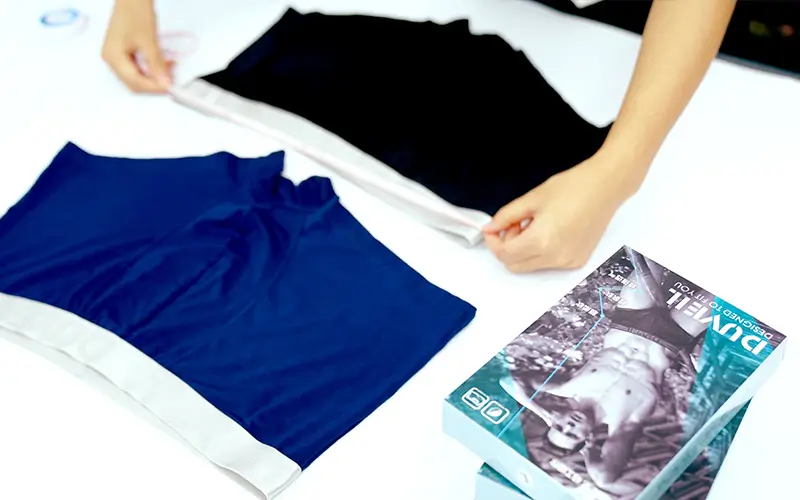
Three construction decisions generate nearly all comfort complaints, and each is set before production. The waistband determines whether the garment stays in place and whether it marks the skin: its width, its elasticity, whether it is woven or knitted, and how it is attached. The pouch construction determines support and how the garment behaves in movement. The leg opening determines whether the garment rides, and it is the component most sensitive to the elastic chosen and the tension used when attaching it.
None of these can be validated from a photograph. The useful verification is a physical sample tested by the intended wearer through several wears and washes, with specific observations recorded: whether the waistband recovers, whether the leg elastic stays flat, whether the seam at the front rise sits where intended. Buyers should ask the factory which of these construction options it produces as standard, because a factory that lists them as options may be offering a construction it does not routinely run.
Fabric composition options on knit underwear programmes: modal, bamboo viscose, combed cotton and performance blends
The fibre choice in underwear is a comfort and cost decision rather than a technical one, and most programmes settle on a small family of blends. Modal and micro-modal deliver a smooth hand-feel and good colour retention. Bamboo viscose is soft and moisture-absorbent. Combed cotton remains the baseline for warmth and familiarity. Blends combining a cellulosic fibre with cotton are common where a brand wants softness with more structure, and blends that add a synthetic fibre with elastane are used where stretch and recovery matter most.
| Blend family | Where it fits | What to verify |
|---|---|---|
| Modal and modal blends | Everyday comfort, smooth hand-feel | Colour retention after repeated washing |
| Bamboo viscose and blends | Warm climates, moisture management | Dimensional stability and labelling |
| Combed cotton and cotton blends | Basics, familiar hand-feel | Shrinkage control and stitch density |
| Cellulosic and cotton blends | Softness with added structure | Blend accuracy against the care label |
| Performance blends with elastane | Active and fitted styles | Recovery after stretch, not just stretch |
Whatever the family, the label claim has to match the delivered fabric, and the fibre naming conventions are regulated in the destination market. The European Commission’s textiles and clothing framework covers the EU position, and the US Federal Trade Commission’s business guidance covers labelling obligations for the US market. Where a fibre claim is certified, GOTS and the Textile Exchange standards programme are the frameworks most often referenced.
MOQ structure for knit underwear: how minimums work per style, colour and size
Underwear minimums are usually expressed per style and per colour, and the fabric is the constraint behind them. A style built on a stocked fabric can open at a lower quantity; a style that requires a new colour or a different blend inherits the minimum of the dye lot. Sizes complicate this further, because a small quantity spread across a wide size range results in very small quantities per size, which affects both the cutting plan and the packing.
Buyers should therefore ask three questions rather than one. What is the minimum per colour, what is the minimum per size within a colour, and does the factory count mixed sizes against a single threshold? The answers determine whether a launch range is feasible in one order or has to be phased. The mechanics behind those thresholds are set out in this explanation of clothing factory MOQ for wholesale buyers.
How the minimum changes when a new colour or fabric enters a knit underwear programme
A new colour is a dye lot before it is a garment, and that is where the cost and the calendar change. Even where the fabric itself is stocked, a colour outside the existing range requires dyeing, which brings its own minimum, its own lead time and a lab dip approval step. The lab dip has to be approved before bulk dyeing starts, so an unapproved colour can hold an entire order at the same point a missing label would.
Fabric changes behave the same way but also affect fit. A heavier or less elastic fabric changes how the garment behaves at the waistband and the leg opening, so a fabric substitution after the fit approval is a new fit evaluation rather than a variation. Buyers planning a range should decide the colour palette before sampling, because a palette confirmed after sampling usually costs a second round.
Sampling sequence for knit underwear: what the fit sample and the PP sample each lock
Underwear sampling runs through the same three stages as other knit categories, with the emphasis on different evidence. The proto confirms that the construction works: that the waistband sits correctly, the leg opening does not ride, and the seams lie flat. The fit sample confirms the measurements against the intended wearer. The pre-production sample confirms the fabric, elastic, colour, labelling and finish that bulk will use.
Because comfort is the product, the fit approval should be based on wear rather than on measurement alone, and the observations should be recorded against named construction points. The record matters more than the sample for the next order, and this sample approval protocol for wholesale orders describes how each approval should be documented.
Decoration and branding on knit underwear: print, embroidery, labels, hangtags and packaging
Decoration on underwear is mostly branding rather than graphics. The visible elements are typically a waistband logo or jacquard, a woven or printed brand label, a care and composition label, and packaging. Each has its own production route and lead time, and the waistband element is the one with the longest lead time because a jacquard or printed elastic is made to order.
Buyers should treat the waistband element as a critical path item and confirm its minimum and lead time at the same time as the garment minimum, since a waistband order can set the programme’s entry quantity. Where a brand wants additional printed decoration, the substrate is stretch knit, which tolerates some methods better than others; testing the print on the actual fabric before bulk is the cheapest way to find the limit.
Testing and audit references are worth agreeing at the same stage, because they determine what the factory has to be able to document. OEKO-TEX Standard 100 is the common baseline for harmful-substance testing on apparel textiles, and amfori administers the BSCI social audit framework that many European buyers ask suppliers to hold. Neither replaces the brand’s own labelling obligations, but both define the documentation a buyer will be asked to work with.
QC checkpoints that decide whether a knit underwear bulk order ships clean
The inspection list for underwear should concentrate on the elements the wearer feels. Measurements at the waistband and the leg opening, elastic recovery after stretching, seam flatness and integrity, colour consistency against the approved standard, and label placement and accuracy. These checks matter more than cosmetic inspection because they predict returns rather than appearance.
Two arrangements make them enforceable. The specification should state a tolerance for each critical measurement, and the factory should check at the point in production where the correction is still possible. A final inspection can classify a waistband problem but cannot fix it; an in-line check can, provided somebody is responsible for acting on the finding.
How to find a manufacturer in China for clothing?
Filter by category first, then by evidence.
Shortlist factories that already produce your garment category, ask each for a comparable specification and sample, and compare on the questions they ask rather than on the price they quote.
Category depth is the first filter because it determines whether the factory owns the relevant capability. A knit underwear manufacturer has the machines, the elastic relationships and the finishing routines your garment needs; a general apparel factory may subcontract the parts of the order it does not routinely run. Confirming the category before discussing price prevents a comparison between a real quote and a guess.
The second filter is how the supplier engages with the brief. A factory that asks about waistband type, elastic recovery and the intended market is reading the specification; one that quotes immediately without a specification is filling a gap. Knitwear Base’s underwear manufacturing programme covers the category end to end, including the fabric families and the construction options described above, which is the kind of category evidence a buyer should expect before placing a first order.
What does an underwear factory need to prove before a first order?
That it produces your construction as standard, not as an option.
Ask for a comparable specification and a physical sample from a programme it has already run, and confirm which of the construction steps it performs on site.
The proof that matters is specific to the garment. A sample of the actual construction — the same waistband type, the same leg finish, the same seam at the front rise — demonstrates capability in a way that a range photograph cannot. Where the factory lists the construction as an option rather than as a routine, the sample may be produced by a different route from the one bulk will take.
Buyers should also ask which steps happen on site and which are subcontracted. Dyeing and specialised elastic production are often external, which is normal, but it means two additional calendars sit behind the garment calendar. Knowing that in advance is what allows a buyer to set realistic approval dates rather than discovering the dependencies after the order is placed.
Conclusion
Underwear is specified in millimetres and judged on comfort, so capability has to be verified on construction rather than on appearance. The four decisions that carry most of the risk — waistband, leg opening, seam type and fabric family — are all fixed before the first sample, and the minimums that follow from colour and fabric choices are usually set before the order exists. Buyers who confirm the construction, check the minimum per colour and per size, and validate fit through wear rather than measurement get a programme that reorders predictably. Buyers who approve a sample on appearance alone renegotiate the same decisions every season.
FAQ
Which fabric blend should we choose for a first underwear range?
Start from the wearer and the market rather than from the fibre. Modal and modal blends suit everyday comfort, bamboo viscose suits warm climates, and combed cotton remains the familiar baseline. The decisive test is how the chosen blend behaves after repeated washing at the intended care conditions.
How do we check waistband quality before bulk?
Test the pre-production sample for recovery after stretching and for dimensional stability after washing, and record the results against the waistband specification. A waistband that measures correctly but loses recovery after twenty cycles will generate returns regardless of how the garment looks.
Does a colour change affect the minimum order quantity?
Usually yes. A colour outside the factory’s existing range requires a dye lot with its own minimum and lead time, and the lab dip has to be approved before bulk dyeing. Deciding the palette before sampling avoids a second round and a higher entry quantity.
What should the care label say on a blended knit?
Fibre composition and care instructions must match the fabric actually delivered, and the naming and language conventions are set by the destination market. The seller of the finished goods carries the obligation, so the label text should be confirmed against the specified fabric before the label order is placed.
Next step. If you are developing an underwear range, send the construction you have in mind and the market you are selling into. The team can confirm which waistband and leg finishes are produced as standard, how the minimum behaves per colour and per size, and what the sampling sequence would cover.
