
A production schedule rarely slips evenly. It holds for weeks and then loses a fortnight in one step, and the step is almost never the sewing. The delays live in the inputs: a measurement that was never confirmed, artwork that arrived after the labels were printed, a fabric booking that started after the sample was approved instead of in parallel with it. Understanding the sequence, and which steps can run alongside which, is what turns a production calendar from a hope into a plan.
The production sequence in one view
Custom apparel production runs through eight stages, and each stage produces the input the next one needs. The sequence is stable across categories, even though the duration of each stage varies with the garment, the fabric and the market. What changes between programmes is not the order of the stages but how much of the work has already been done: a style in the supplier’s existing range starts at stage three, while a new construction starts at stage one.
| Stage | Output that unlocks the next stage |
|---|---|
| 1. Brief and tech pack intake | A specification complete enough to quote and to build from |
| 2. Pattern, grading and proto | A first physical sample and a measurement set |
| 3. Fit sample and comment round | An approved fit, with written corrections |
| 4. Fabric and trim booking | Materials on order or in house, with receipt checks planned |
| 5. Pre-production sample and bulk approval | A signed production standard covering materials and finish |
| 6. Cutting, sewing and in-line checks | Garments made to the approved standard, with deviations recorded |
| 7. Finishing, inspection and packing | Retail-ready units packed to the agreed carton plan |
| 8. Documentation and shipment | Packing list, invoice and shipping documents against a delivery term |
Stage 1: brief and tech pack intake
Everything the programme will be judged against is fixed at intake, which is why an incomplete pack is expensive even though it costs nothing at the time. A usable pack states what the garment is, how it is constructed, what it is made from, how it is sized and how it is packed. Where any of those are absent, the supplier either asks questions, which consumes calendar, or makes assumptions, which consume the order later.
The intake review should be treated as a formal step rather than a courtesy. Both sides should be able to state what is included and what is still open, and the open items should be listed with an owner and a date. A brief with three open questions and dates is in better shape than one that appears complete but leaves the fabric weight implied, because implied details are the ones that get filled with whatever was available on the day.
Stage 2: pattern, grading and the proto
Pattern work converts the specification into a shape that can be cut, and grading converts that shape into a size set. The proto then tests whether the construction works at all: whether the seams hold the intended shape, whether the components sit where the drawing placed them, and whether the proportions read as intended on a body. The proto is not a fit approval; it is a construction test, and treating it as both is how brands end up approving measurements from a sample that was never meant to define them.
Grading should be settled alongside the pattern rather than after it, because the two interact. A measurement that is correct at the centre size can produce an unworkable grade at the extremes, and discovering that at the fit stage means re-grading rather than adjusting. Suppliers that hold established blocks for their categories can shorten this stage considerably, since only the specific pattern has to be produced.
Stage 3: the fit sample and the comment round
The fit sample is where measurements and the block are agreed, and where the comment round has the highest value. Comments work when they are specific and referenced: this measurement at this size should move by this amount, judged on this body. Comments that describe a preference without a measurement — “feels tight”, “looks long” — are interpreted, and the interpretation may not match the intention.
The stage closes when the corrections are recorded and the revised measurement specification is issued. That record is what the bulk will be checked against, so it is worth more than the sample itself. Buyers should also decide at this point which measurements are critical to fit and which are nominal, because inspection effort should be concentrated on the first group. The wholesale sample approval protocol describes how each approval should be documented so that the record survives a change of personnel on either side.
Stage 4: fabric and trim booking
Material booking is the longest external dependency in most programmes and the stage where parallelism pays most. Fabric and trims can be ordered once the specification is fixed, which in many programmes is at the end of stage three rather than after the pre-production sample. Waiting for the sample to be approved before booking material puts the material lead time on the critical path when it did not need to be there.
Booking also establishes the risks that will be managed later. The party that books carries the minimum, and the party that books is usually the party that inspects on receipt. Buyers should confirm who checks the delivered material against the approved reference, what happens if a shade band differs between rolls, and whether surplus material can be used for a later order or belongs to the brand. Material that arrives with an unrecorded deviation is discovered after cutting, where there is no economical remedy.
Stage 5: the PP sample and bulk approval
The pre-production sample is the most consequential approval in the sequence, because it is the last point at which the programme can change direction cheaply. It confirms the materials that will actually be used in bulk, the colour against the approved standard, the trims and labels, the decoration placement, and the finish. Where the fit sample settled measurements, the pre-production sample settles everything else.
Two things should be true before bulk starts. The pre-production sample should be approved in writing against a reference, and it should be retained as the standard against which the delivered goods are compared. A programme that approves by email and does not retain the sample has an approval that cannot be enforced. Buyers should ask where the sealed standard is held and who can access it, because the answer determines how a dispute about delivered goods will be resolved.
Stage 6: cutting, sewing and in-line checks
Production proper begins with cutting, and cutting is where material efficiency and size accuracy are decided. The marker determines consumption, so any change to the fabric width or the size ratio changes the yield and therefore the cost. Sewing follows in the sequence the construction requires, and the in-line checks are what catch drift while it is still correctable: a measurement moving outside tolerance on one size, a shade difference appearing between rolls, a print sitting outside the approved position.
In-line control only works when it happens during production rather than at the end. Final inspection can classify defects but cannot prevent them, and by the time a systematic issue is visible in the finished goods, the material and the labour are already spent. Buyers should ask what the in-line check looks for, at what interval, and how findings are recorded and escalated. The factory QC process used on wholesale apparel orders sets out what a working inspection sequence looks like.
Stage 7: finishing, inspection and packing
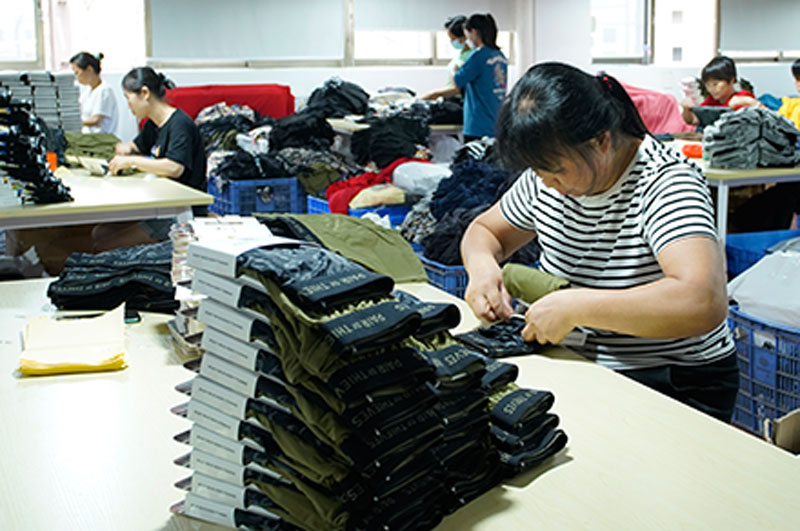
Finishing covers trimming, spot cleaning, pressing, measurement verification against the approved specification, and folding to the agreed presentation. Inspection then confirms that the goods match the standard, and packing converts them into the unit the buyer will receive: folded to specification, labelled, bagged where required, and packed to a carton plan that states either a piece count or a weight limit.
This stage is where private label components come together, and it is also where a late approval is most expensive. A hangtag that arrives after packing forces the cartons to be reopened, and a change to the folded presentation changes the carton count, which changes the freight calculation. Buyers who lock the packing specification early and order the label components against the production calendar rather than against the shipping date avoid both problems.

Stage 8: documentation and shipment
The final stage converts packed goods into a delivered consignment. It covers the packing list and invoice, the shipping documents required for the route, and the delivery terms that determine who arranges freight, who clears the goods and where risk transfers. Documentation problems surface late and cost disproportionately, because goods cannot leave a port without correct paperwork and storage charges accrue in the meantime.
Two preparations prevent most of them. Confirm who prepares each document, and confirm it before production ends rather than before the vessel sails. And fix the delivery term in writing at the quotation stage, so that the party responsible for freight and clearance is known in advance. The ICC Incoterms rules provide the standard vocabulary for that term, and the frameworks used for material and workplace claims — OEKO-TEX Standard 100 for textile safety testing, amfori for social audit, and WRAP for certified facility compliance — determine which supporting certificates may be requested alongside the shipment.
Where a test result has to accompany the goods, agree which standard the test will be reported against. The ASTM standards programme for textiles and the published test scope from laboratories such as Intertek’s textiles and apparel testing service give both parties the same basis for describing what was tested.
Where the production process actually stalls
Stalls cluster in five places, and four of them are inputs rather than production steps. Incomplete tech packs stop the quotation and the pattern work. Slow comment rounds stop the fit approval, because comments arrive in batches rather than as they are found. Late artwork stops the pre-production sample, because the sample cannot carry final branding until the artwork exists. Late material booking moves the longest external dependency onto the critical path. And late approval of the sealed standard stops cutting, which is the point at which the whole calendar becomes unrecoverable.
The pattern is consistent enough to be planned for. Every one of those stalls is caused by a decision that could have been scheduled earlier, and none of them is caused by production capacity. Programmes that publish a decision calendar alongside the production calendar — with a date for every approval the brand owes — lose far less time than programmes that treat approvals as responsive activity.
Which stages can run in parallel to shorten a run?
Material booking and artwork can run alongside sampling.
Fabric and trim booking can start once the specification is fixed, and label artwork can be approved during fit sampling, provided neither is changed by the sample outcome.
The parallelisable steps are the ones whose inputs are already fixed. Material depends on the fabric specification, not on the fit result, so it can be ordered as soon as the specification is confirmed in writing. Label and packaging artwork depends on the composition text and the brand assets, neither of which changes with a fit correction, so it can be approved and ordered during the sampling window. Long-lead components of the construction, such as a specific zipper or a custom knit, can be reserved at the same time.
Two constraints keep parallelism safe. Nothing can be ordered against a specification that is still open, because a later change converts committed material into dead stock. And the pre-production sample still has to be approved before bulk, regardless of how far ahead the materials were booked, so the parallel track shortens the programme without removing the control. Buyers who accept those constraints typically remove the material and label lead times from the critical path and gain the weeks that programmes usually lose at the end.
Conclusion
The custom clothing production process is a sequence of eight stages in which each stage exists to produce the input the next one needs. The technical work — pattern, grading, cutting and sewing — is the part suppliers control most reliably. What varies is the speed of the decisions around it: a complete tech pack, specific fit comments, artwork approved before the pre-production sample, material booked as soon as the specification is fixed, and a sealed standard that governs bulk. Buyers who schedule those decisions and run material and labelling in parallel with sampling keep the calendar they started with. Buyers who treat approvals as responsive activity lose the same two or three weeks on every programme and usually blame production for it.
Next step. If you have a programme in development, send the tech pack and the dates you are working to. The team can confirm which stages can run in parallel for your construction, and which decisions need to be made first for the calendar to hold.
FAQ
Can we skip the proto if we already sell a similar style?
Sometimes, when the construction is genuinely unchanged and the supplier already holds the block. If any element is new – a different fabric weight, a changed component or a new decoration position – the proto is the cheapest place to find out that the construction needs adjusting.
When should fabric be booked?
As soon as the fabric specification is confirmed in writing, rather than after the pre-production sample is approved. Booking early removes the longest external dependency from the critical path, provided the specification is genuinely closed and will not change as a result of the sample.
What is the difference between the fit sample and the pre-production sample?
The fit sample settles the measurements and the block. The pre-production sample settles the materials, colour, trims, labels, decoration placement and finish. A programme needs both approvals because they lock different things, and the bulk is compared against the pre-production standard.
Who should hold the sealed approved sample?
Ideally both sides hold one, and the agreement states which copy governs in the event of a dispute. The supplier’s copy guides production; the buyer’s copy is the reference for the delivered goods. An approval without a retained sample is difficult to enforce.
