

Short answer: a clothing production lead time is the sum of several stages: sampling and approval, fabric and trim booking, cutting and sewing, any decoration, inspection and packing, then freight. Some of those can run at the same time and some cannot. When an order is late, the cause is usually a stage that started late (often an approval or a fabric booking), not a sewing line that ran slowly. The useful question is which stages are on the critical path for your order.
There is no honest single figure for “how long clothing production takes”; it depends on the product, the fabric, the quantity and the factory’s load. This page shows how to build and check a timeline rather than quoting typical weeks.
The stages inside a lead time
| Stage | Who controls it | Can it overlap with others? | Common cause of delay |
|---|---|---|---|
| Tech pack and quotation | Buyer and factory | Partly, with early sampling | Incomplete specification; quotes on different bases |
| Sampling rounds (proto, fit, size set, PP) | Mostly the buyer’s approval speed | Fabric can be booked once the fabric is approved | Slow or conflicting comments; extra rounds |
| Lab dips and strike-offs | Mill or printer, then buyer approval | Yes, alongside fit sampling | Approval waiting; re-dips |
| Fabric and trim booking and production | Mill and trim suppliers | Yes, once fabric and colour are approved | Booking only after PP approval; custom trims with long lead times |
| Fabric inspection and shrinkage test | Factory | Short; just before cutting | Fabric failing weight or shade |
| Cutting, sewing, decoration | Factory and any subcontractor | Decoration can overlap with sewing | Line capacity; subcontracted print or embroidery |
| Finishing, packing, final inspection | Factory, inspector | Inspection when most is packed | Inspection booking; rework after a failed inspection |
| Freight and customs | Forwarder, carrier, broker | No; after shipment | Booking, port congestion, customs holds |
The factory’s quoted “production lead time” often covers only fabric through packing, after PP approval. Ask exactly which stages a quoted number includes.
Find the critical path
The critical path is the longest chain of stages that must happen one after another. On many knit orders it runs through fabric: fabric cannot be produced until fabric and colour are approved, and cutting cannot start until fabric arrives and passes inspection. Two practical consequences:
- Approve fabric and colour early. If the fabric and shade are approved during fit sampling, the mill can work while the fit is finalised.
- Order long-lead trims early. Custom waistbands, woven labels, printed packaging or special zips can take longer than the garment. Ask each component’s lead time at quotation.
Stock fabric and stock trims shorten the path; custom-developed fabric lengthens it. Choosing between blanks, stock-fabric cut-and-sew and fully custom fabric is the biggest lead-time lever; see how to get shirts made quickly.
Why two factories quote different lead times for the same garment
- Different start points: one counts from order, the other from PP approval.
- Different end points: ex-factory versus arrival at your warehouse.
- Fabric in stock versus to be made.
- Current line load and other customers’ orders.
- Subcontracted steps such as printing or washing.
Ask each factory for a dated timeline with the same start and end points, the stage dates, and what each date depends on. A quote with stage dates is easier to check than a single number.
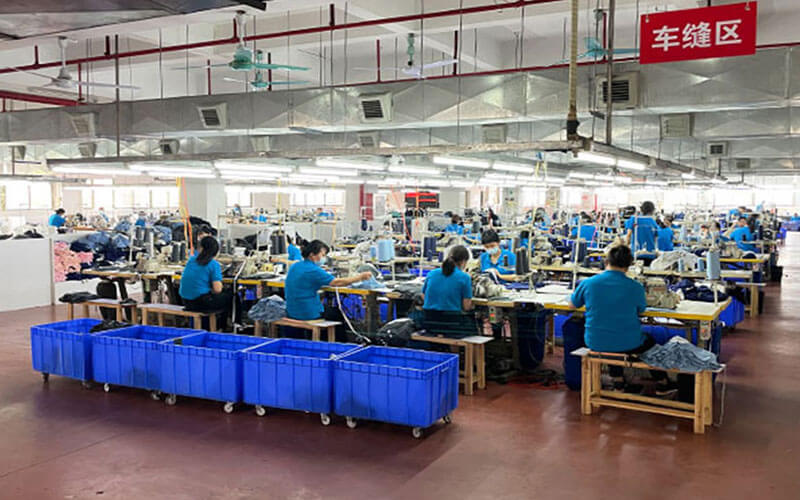
A timeline template to ask factories to fill in
Ask each candidate to complete the same table with dates, not durations, for your order. The structure makes gaps and assumptions visible; the dates are theirs to commit to.
| Milestone | Planned date | Depends on | Owner |
|---|---|---|---|
| Tech pack and quote confirmed | [date] | Complete specification | Buyer / factory |
| Fit sample sent / approved | [date] / [date] | Pattern; buyer comments | Factory / buyer |
| Fabric and colour approved | [date] | Lab dip approval | Buyer |
| Fabric booked / arrives | [date] / [date] | Fabric approval; mill capacity | Factory / mill |
| Trims and labels arrive | [date] | Artwork approval | Factory / suppliers |
| PP sample approved | [date] | Production materials present | Buyer |
| Cutting starts | [date] | Fabric passed inspection; PP approved | Factory |
| Final inspection | [date] | Most of order packed | Inspector |
| Ex-factory / ship date | [date] | Inspection passed; booking | Factory / forwarder |
| Arrival at warehouse | [date] | Freight mode; customs | Forwarder / broker |
When the delivery date is already fixed
If the in-store or launch date is fixed, plan backwards from it: freight, then inspection and packing, then production, then fabric, then approvals. If the result is a start date in the past, something has to change: a stock fabric instead of a developed one, fewer colours, a split shipment, or a later launch for part of the range. Decide that before the order, not when it is late.
Freight and the delivery window
Freight is not part of the factory’s production time but is part of yours. Ocean and air differ in time and cost, and the Incoterms rule in the quote decides who books and pays for which leg. See shipping and freight for wholesale apparel and, if an order is already late, whether to air-freight a delayed order.
Holidays and seasonal peaks
Factories in China close for Chinese New Year, and workforce return afterwards can be gradual. Peak seasons also tighten mill and freight capacity. Plan around them rather than assuming normal speed; see ordering around Chinese New Year.
Keeping the timeline on track
- Agree the dated timeline at order confirmation, with stage owners.
- Turn sample comments around quickly and consolidate them into one instruction.
- Ask for fabric booking and arrival dates, and the fabric inspection result, as soon as they exist.
- Ask for weekly status against the timeline; see what to ask each week.
- Book final inspection and freight in advance of the ex-factory date.
Fact, advice and uncertainty
Fact: a lead time is a sequence of stages; fabric booking and approvals often sit on the critical path. Advice: compare quotes on a dated, stage-by-stage timeline with the same start and end points. Uncertainty: mill capacity, freight markets and holidays change; re-check timelines before each order.
For minimums, which also affect timing, see how MOQs work. For the full sequence see the custom clothing production process, or contact Knitwear Base through the contact page.
Sources and further reading
Rules and standards are summarised from their official pages for general guidance; this is not legal advice. Check the current version and the requirements of your own market before you rely on them.
