
The word factory is used for four different kinds of business, and the differences between them decide who carries the risk when something goes wrong. Knowing which tier you are buying from is not a matter of suspicion; it is the difference between a supplier who can change a setting on the line and one who has to ask somebody else to do it.
The four supply tiers and why it matters which one you signed with
The four tiers are the factory that owns the machines, the trading company with an affiliated line, the agent or sourcing office, and the marketplace reseller. Each changes price, lead time and who is accountable for quality.
The tiers are distinguished by one question: does the business you are contracting with control the machines that will make your order? Everything else follows from that answer. A factory that owns its floor can change a setting, retime a line and inspect its own work. A business that does not own the floor can do none of those things directly, and its value lies in coordination, aggregation or access.
None of the four is inherently dishonest, and each is the correct choice for a different kind of buyer. The problem arises when a buyer believes they are contracting with one tier and is actually contracting with another, because the expectations they formed about control, timing and accountability no longer match the structure they bought.
| Tier | Owns the machines | Best suited to | Main exposure |
|---|---|---|---|
| Factory | Yes | Defined specifications and repeatable volume | Higher minimums, less flexibility on small orders |
| Trader with a line | Partly | Orders spanning styles or processes | Unclear which parts run on which floor |
| Agent or sourcing office | No | Unfamiliar categories and market entry | Margins on material as well as labour |
| Marketplace reseller | No | Stock, samples and small quantities | No control over construction, fabric or colour |
Tier 1: the factory that owns the machines
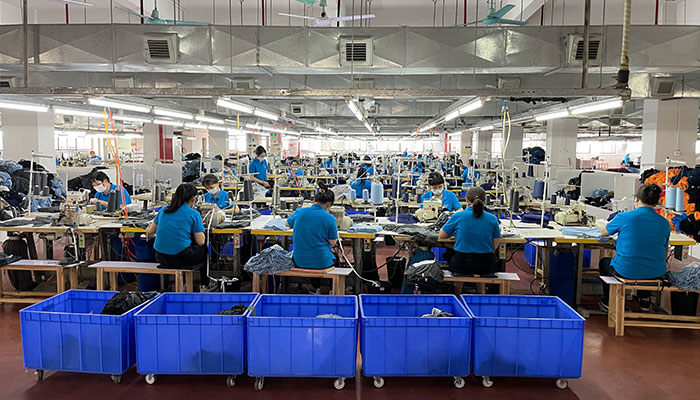
A tier one supplier owns the building, the machines and the workforce, and it is accountable for the order through the whole of the production process. It quotes against your specification, holds the production schedule, runs its own quality checks and is the party that can actually change a machine setting when a measurement drifts.
The advantages are direct control and a single point of responsibility. When something goes wrong, the conversation is with the party that caused it rather than with a coordinator. The trade-off is commercial: an owned floor has to be kept busy, so minimums are set by the smallest quantity that keeps a line economic, and flexibility on small or unusual orders is limited.
Where the factory also owns the development stage, the advantage compounds. A pattern room inside the building means a measurement comment can be turned around by the person who drew the block, which shortens the sample cycle in a way no amount of communication discipline can reproduce. Development scope and the sequence that follows it are described in this overview of apparel design and development.
Tier 2: the trading company with an affiliated line
A trading company with an affiliated line is a hybrid, and it is the most common structure in apparel sourcing. The business owns some production capacity and buys the rest, which allows it to accept an order that spans several fabrics or processes without turning any of it away. Its margin pays for coordination, and at its best the coordination is substantial: dividing the work between floors, managing several schedules and taking responsibility for the finished order.
The exposure is visibility. When a company owns part of a line and buys the rest, the buyer rarely knows which part of the order is made where, which matters when a problem appears late and the answer determines whether it can be fixed before the vessel sails. It also matters for compliance, because a social audit covering the owned site does not speak for the subcontracted one; Sedex holds SMETA reports and amfori administers the BSCI framework, both of which name the sites they cover.
Two questions resolve the structure quickly. Which processes in this order would run on a floor the company owns. And which legal entity is named in the contract, because the answer determines who is liable if the order fails. Where the order moves across borders or between sites, the parties’ responsibilities for carriage and clearance should be named explicitly, and the ICC Incoterms rules define what each delivery term includes.
Tier 3: the agent or sourcing office
An agent does not own production and does not intend to. The service is access: finding factories in a category, negotiating, coordinating quality and managing logistics on the buyer’s behalf. For a buyer entering an unfamiliar category or market, an experienced agent can compress months of searching into weeks, and a good one will decline a factory that is not suited to the order.
The cost structure is where the tier differs most. An agent may charge a percentage commission on the order value, a monthly retainer, a fee per order, or a margin on the material rather than on the labour, and the last of those is the hardest to see. A commission on the order total is straightforward and accumulates with volume; a material margin is invisible in the unit price unless the buyer knows the mill price.
Three questions make the position clear. How the agent is paid, and on what base. Which factories it works with for this category and whether it has exclusivity with any of them, since an exclusive relationship can quietly become the only option. And what happens if the buyer wants to contract with the factory directly later, which is better settled at the start than in the middle of a programme.
Tier 4: the marketplace reseller
A marketplace reseller sells goods that exist or that can be made to a template. The offer is speed and small quantity: stock items, samples and low-volume runs of a design that the reseller controls. For testing a market, filling a gap or buying samples to assess quality, this tier is genuinely useful and often faster than any other route.
What it cannot offer is control over the specification. The construction, the fabric and the colour belong to the reseller, and the buyer chooses between products rather than specifying one. Where a distinctive fabric or a measured fit is part of the product, the tier is a dead end for production and a reasonable route for reconnaissance.
One caution is worth stating plainly. Materials and finished goods bought through this tier often arrive without the test reports or the traceability that a claim would require, which matters when a market requires evidence about fibre content or restricted substances. Testing frameworks such as OEKO-TEX Standard 100 name the articles they cover, and a report for a similar product is not a substitute for one naming the item being sold.
How to identify the tier from the first conversation and the paperwork
The tier is usually visible within two exchanges, and it is visible in the questions the supplier asks rather than in the answers it gives. A factory asks about the construction, the fabric and the quantity. A trading company asks about the order as a whole and about timing. An agent asks about the buyer’s requirements and the market. A reseller asks which product from the range.
The paperwork confirms what the conversation suggests. An invoice and a bank account whose names match the contract indicate a direct relationship; a mismatched set is the classic structure in which payment is difficult to recover. A certificate of origin and a social audit report that name a site rather than a group indicate a supplier with a specific floor in view. And a delivery term that is stated explicitly indicates a supplier used to allocating responsibility, since the customs procedures and documentation expectations attached to cross-border shipments are framed by the WTO Trade Facilitation Agreement and, for entry to the United States, interpreted by US Customs and Border Protection.
Two documents settle the question outright. The business licence, which names the legal entity and its registered scope, and the site address in the contract or the audit report, which names where the work happens. Where those two agree with the quotation, the tier is confirmed.
What each tier does to price, lead time and accountability
Price rises as the tier moves away from the machines, but not by the amount buyers assume, because the intermediate tiers usually substitute their own coordination for the factory’s sales effort. The larger effect is on lead time and accountability, where the tiers behave very differently.
| Tier | Price effect | Lead time effect | Accountability |
|---|---|---|---|
| Factory | Lowest for its own category at its own minimum | Single schedule under one control | Direct, with the party that made the goods |
| Trader with a line | A coordination margin on part of the order | Two schedules to reconcile where work is subcontracted | Contractual, but split across floors |
| Agent | Commission or a material margin | Adds a communication layer between buyer and floor | Advisory rather than productive |
| Marketplace reseller | Lowest unit price, least specification control | Fastest for stock, least predictable for custom | Product-level rather than order-level |
The lead time effect is where the difference is felt. A factory’s schedule is one sequence of events; a coordinated order is several sequences that have to arrive together, and each additional floor adds a point at which a delay can originate. That is not an argument against coordination, because a coordinated order can do work no single factory would take. It is an argument for knowing which structure is in place, so that the schedule is built with the right number of dependencies in it.
Choosing the tier that fits your volume and category
The match is made on three properties of the order: whether the specification is distinct enough that the construction matters, whether the volume meets a factory minimum, and whether the category is one you can assess yourself. A distinctive product at a workable volume points to the first tier. A mixed order spanning styles points to the second. An unfamiliar category or a market entry points to the third. A test of a market or a sample requirement points to the fourth.
The commercial threshold is what usually decides it. Where the volume is below a factory minimum, the realistic options are to combine styles to reach it, to accept a lower tier with a margin, or to reduce the initial range. The way the minimum is expressed per style, per colour and per fabric, and how a smaller order can be structured around it, is set out in this explanation of factory minimum order quantity.
Whichever tier is chosen, the questions that establish what it can commit to are the same, and the answers that separate a supplier with a floor from one with a desk are easier to read once the tier is known in advance. The set of questions worth asking every supplier is described in this guide to the questions to ask a clothing manufacturer.
Conclusion
Four tiers sell clothing from China, and they differ by one fact: whether the business you contract with controls the floor that makes the order. The factory gives direct control and higher minimums, the trading hybrid gives aggregation and split accountability, the agent gives access and a fee structure worth understanding, and the reseller gives speed with no specification control. Identify the tier from the questions asked and the paperwork produced, choose it against your volume and category, and the rest of the supplier conversation becomes much easier to interpret.
FAQ
Is buying from a trading company worse than buying from a factory?
Not by itself. A trading company can run an order that spans styles or processes no single factory would take, and the margin pays for that coordination. The question is whether the layer adds function to your order or only cost.
How can I tell which tier I am dealing with?
From the questions the supplier asks and from the paperwork. Ask which legal entity would be named in the contract, whether that entity owns the production site, and whether the business licence and the bank account names match the quotation.
Do agents charge differently from factories?
Yes. An agent may take a percentage of the order value, a retainer, a fee per order, or a margin on the material, and the last is the least visible. Ask how the fee is calculated and on what base before the first order.
When is a marketplace reseller the right choice?
For stock items, samples and small quantities, and for assessing quality before committing to a production programme. It is not the right route where construction, fabric or colour form part of the product.
Next step. If you are unsure which tier you are dealing with, send the quotation and the category. The team can confirm what the structure implies for lead time and accountability, which parts of the order would run on site, and how the commercial threshold applies.
