
Speed in garment production is rarely produced by working faster. It is produced by removing decisions from the critical path, and most of the decisions that delay an order belong to the buyer rather than to the factory. A supplier that quotes an unusually short lead time is usually describing a programme in which nothing has to wait for an answer, which is a statement about the brief as much as about the floor.
Apparel Manufacturer with Fast Turnaround: what actually compresses a timeline
Four things compress a timeline, and none of them is a machine running longer. Fabric that is available rather than booked. A specification that is complete, so no question has to be answered before work can start. An approval cycle measured in hours rather than in days, which is a buyer-side commitment. And a production slot that the factory can actually allocate, which is a scheduling fact rather than a promise about effort.
Two of those belong to the buyer, which is why a brand can fail to hit a short window with a fast factory and succeed with a slower one. A mill lead time of several weeks cannot be compressed by urgency; it can only be avoided, by choosing a fabric that exists. An approval that takes a week costs a week regardless of how quickly the factory responds to it.
The practical way to plan a short lead time is to list every stage and mark it as a decision, an activity or an approval. Decisions can be pre-made, approvals can be pre-scheduled, and activities are the only part that genuinely takes the time the supplier quoted.
The stages that can run in parallel, and the ones that cannot
Parallel planning is where most of the available time sits. Trims, labels and packaging can be ordered while the sample is in review, since their specifications rarely depend on the fit outcome. Fabric booking can be released against a specification with the shade confirmed later, provided the mill accepts a colour approval that follows the booking. Freight can be reserved before the goods are packed. Inspection can be scheduled against the production finish date rather than waiting for the goods to be ready.
What cannot overlap is anything that depends on an approval. Cutting waits for the pre-production sample, and sewing waits for cutting. Where a programme has three sample rounds, the rounds are sequential by definition, which is why the fastest programme is usually the one that needs the fewest rounds rather than the one that runs them most quickly.
Two controls make parallel planning real. Ask the factory which stages it can begin before approvals and which it cannot, because the answer varies between suppliers and is rarely offered. And put the buyer’s own approval dates into the calendar alongside the factory’s, since they are the only dates the buyer can guarantee and the ones that most often move. The commercial terms that govern a first order of this kind are set out in this explanation of factory minimum order quantity.

| Stage | Can it run in parallel? | What it waits for |
|---|---|---|
| Trims, labels and packaging | Yes | Nothing, once the specification is fixed |
| Fabric booking | Usually | A colour approval can follow the booking |
| Sampling | No | The brief, then the previous round’s comments |
| Cutting | No | The pre-production approval |
| Freight booking | Yes | Only the carton plan |
Sorting the stages this way shows where a short window is actually won. Three of the five can move in parallel with the sample, so a programme that waits for the fit approval before ordering trims and reserving freight has added weeks that the factory never quoted.
Sampling: the fastest route through the approval cycle
The sample rounds are the part of the calendar the buyer most directly controls, and they are also the part most often extended by the brief rather than by the factory. A round is repeated when the brief was incomplete, when the measurement table had no tolerances, when comments were issued in a stream rather than as one set, or when a decision changed between rounds. Each of those is a decision that could have been made earlier.
Three practices shorten the cycle without cutting a corner. Send one consolidated comment set rather than a sequence of messages, because a supplier acting on the first and the last message will miss the middle. Reference each comment to a photograph with the measurement marked, since a shared visual removes the ambiguity about which dimension is meant. And decide the material before the fit round rather than after, because a material change reopens a question that had already closed.
Where the schedule is genuinely short, the alternative to compressing the rounds is to reduce their number deliberately: a proto and a pre-production sample can sometimes carry a programme if the measurements are supplied by the buyer rather than developed, which trades a design step for a schedule. What that trade costs in fit risk should be a decision rather than an accident.
Fabric: stock availability versus mill lead time
Fabric is the longest dependency in most programmes and the one with the least elasticity. A mill lead time covers knitting or weaving, dyeing, finishing and packing, with a lab dip and its approval preceding the dyeing where the colour is developed. None of those steps responds to urgency; they respond to capacity, and capacity is booked in advance.
That produces the single most effective speed decision available to a buyer: choose from fabric that exists. A stock-service fabric in a standard colour can be available in days rather than weeks, and the cost is a narrower choice of composition, weight and shade. A developed colour in a developed fabric is the slowest option and the one that produces the most distinctive product.
The middle route is worth understanding because it is where many short-window programmes land. Where a mill holds greige and the colour is standard, the lead time collapses to the dyeing and finishing window, which is far shorter than a full development cycle. Where the colour still has to be matched, the lab dip returns to the critical path, and the approval is once again a buyer-side decision that can be made in hours or in days. The three tests worth agreeing with the fabric order, and the reason they belong before the order rather than after it, are set out in this guide to apparel fabric sourcing in China.
Inspection that keeps pace without being skipped
Inspection is the stage most often sacrificed for speed and the one where the sacrifice is least necessary. The three checks do not all cost time. An incoming material check happens before cutting and protects the whole run. A first-off check takes one garment and prevents an error from repeating. An in-line check runs alongside production rather than after it. Only the final check sits on the critical path, and it can be scheduled against the production finish date rather than requested when the goods are ready.
The time cost of inspection is therefore mostly in the final stage, and the way to compress that stage is to prepare it. Agree the standard before production, so the inspector has a reference rather than a brief. Agree the sampling plan before production, so the inspection time is resourced. And schedule the visit against the production dates, because a pre-shipment inspection that arrives after packing can classify a lot but cannot change it. The physical vocabulary for the properties under test is published in the ASTM standards programme for textiles, and the scope a laboratory applies to apparel is published, as Intertek’s textiles and apparel testing range illustrates.
What a genuinely fast manufacturer looks like in the paperwork
Speed is visible in paper before it is visible on the floor. A supplier that can quote a short window quickly usually asks specific questions: which fabric and whether it is a stock item, which trims already exist, whether the pattern and the grade are supplied, and which market the goods are for. Those questions indicate a supplier mapping the critical path rather than a supplier offering enthusiasm.
Three documents signal the same thing. A quotation that separates the sampling, fabric and production windows rather than quoting one figure. A production calendar with dated stages rather than durations. And a delivery term named explicitly, because the term decides who arranges the freight and therefore who can be late; the ICC Incoterms rules define what each term includes. Where those three exist, the quoted lead time is a plan; where they do not, it is an estimate.
A fourth signal is the audit file. Where the certifications the market requires are already held by the site that will make the order, no assessment has to be scheduled inside the window, and the frameworks that publish those standards make the check quick; amfori administers the BSCI framework for workplace assessment and Sedex holds SMETA reports.
The commercial structure behind a speed claim is worth checking in the same way. A supplier that will quote a short window on a first order is making assumptions about the specification, and a programme that reaches the line with those assumptions unchanged is the one that keeps the date.
Where speed is bought with risk
Not every week saved is free, and four shortcuts transfer cost rather than remove it. Skipping the pre-production approval moves a material decision into production, where a change is expensive. Substituting a fabric to meet a date moves the risk to the shade and the shrinkage, which appear after the goods are sold. Compressing inspection moves the risk to the customer, and it is the shortcut most likely to produce a return rather than a delay. And air freight used to recover a late production date converts a schedule problem into a cost that is already sunk by the time it is paid.
The pattern is that genuine speed comes from removal of waiting, and false speed comes from removal of verification. The first is achieved by pre-making decisions, pre-approving materials and ordering trims in parallel. The second is achieved by dropping the checks, and it is only cheaper until the first return.
Air freight deserves a note of its own, because it is the recovery most often reached for and the one whose cost is hardest to recover. Where the goods have to move by air, the handling and unit-load requirements the carriers work to are set out by the IATA cargo programme, and the carton dimensions that satisfy a sea shipment may not satisfy an air one. Budgeting for the possibility in advance is cheaper than discovering it in the week the goods are late.
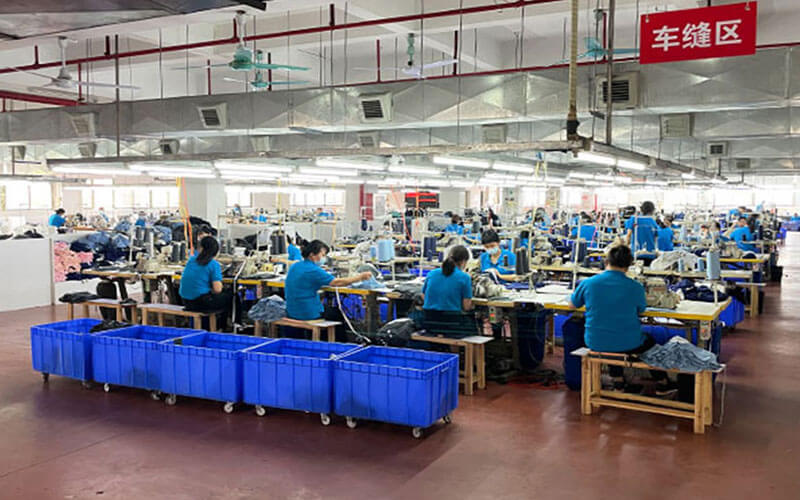
What do the “top manufacturer” lists actually measure?
Reach and revenue, not turnaround or fit for your order.
Published manufacturer rankings are usually built on company size, revenue and export volume, none of which predicts how quickly a specific order would move or whether the factory wants it.
The metrics that appear in ranking lists describe scale. Revenue, number of employees, export value and the number of countries served are all available from public sources, which is why they appear in rankings, and none of them is a statement about the floor. A very large factory can be slow for a small order because the order has to compete for a slot with larger ones, and a specialist with a fraction of the revenue can be fast because the category is what it runs every day.
What predicts turnaround is closer to home: whether the fabric is a stock item, whether a line is available in the window, whether the pattern is supplied or must be developed, and whether the required certifications are already held. Those four questions are answerable in a first conversation, and they are also the questions that determine whether the quoted date is real. The programmes that assess a factory on evidence rather than on a listing are described in this clothing manufacturer audit checklist.
Conclusion
A fast turnaround is a property of the programme rather than of the factory alone. Choose fabric that exists, hold the specification complete, pre-schedule the approvals the buyer owns, run the trims and the freight booking in parallel, and keep the inspection stages while compressing only the final one. Where a week has to be found, take it from waiting rather than from verification, because a date recovered by skipping a check is usually paid for later as a return, and a date recovered by pre-making a decision costs nothing at all.
FAQ
What actually shortens a garment lead time?
Fabric that is available rather than booked, a complete specification, approvals taken quickly, and a production slot that exists in the window. Only the last is the factory’s; the rest are decisions the buyer can pre-make.
Can sample rounds be run faster?
The rounds can be shortened with one consolidated comment set, photographs with measurements marked, and the material decided before the fit round. The larger saving is having fewer rounds, which comes from a complete brief rather than from speed.
Does a large manufacturer deliver faster?
Not necessarily. Size predicts capacity rather than priority, and a small order can wait behind larger ones at a large factory. What predicts turnaround is whether the fabric is stock, whether a line is free and whether the pattern already exists.
Is air freight a solution to a late order?
It is a recovery, not a solution. The production date has already been missed, so the freight cost is a sunk expense rather than a saving, and the underlying cause of the delay usually remains in the next programme.
Next step. If you are working to a fixed launch date, send the window and the category. The team can confirm which stages can run in parallel, which fabric options would shorten the critical path, and where the approvals need to sit.
