
“Full service” is the most elastic phrase in apparel sourcing. Two suppliers can both use it while one is quoting cut-and-sew only and the other is carrying fabric, labels, packaging and export documentation. The difference is invisible in a quotation summary and very visible in the fourth week of a production run, when somebody has to own a fabric delay, a missing label approval or a size-grading correction. Scope is the single most useful thing to pin down before price, because price is only meaningful once scope is fixed.
What does full-service custom apparel manufacturing actually include?
Development, materials, making, finishing and shipping.
A genuine full-service scope covers pattern and sample development, fabric and trim sourcing, cutting and sewing, decoration, finishing and packing, and export documentation — with a named owner for each.
The test of a full-service offer is not the length of the service list but whether each item has an owner and a trigger. Development has an owner when someone is accountable for the pattern and the graded set. Materials have an owner when one party is responsible for booking, inspecting and holding the fabric. Production has an owner when in-line and final checks are somebody’s job rather than everyone’s. Packing and documentation have an owner when the carton specification and the shipping documents are produced against a standard rather than assembled at the last minute.
Knitwear Base, for example, runs development through to packing in-house across its knit categories, and that continuity is what makes a single scope possible: the factory profile sets out where the work sits. A supplier that outsources several of those blocks can still offer full service, but the handoffs between its subcontractors become the buyer’s risk unless they are described.
Where the scope usually stops: four handoffs buyers miss
Scope disputes cluster at four boundaries, and all four appear in offers that read as complete. The first is the pattern: whether the supplier delivers a digital pattern and graded set, or keeps them. The second is the fabric: whether the supplier books and owns the material, or merely sews what the buyer supplies. The third is the trim and label pack: whether the supplier sources labels, care labels and packaging, or waits for the buyer to send them. The fourth is the exit: what happens to tooling, surplus material and unshipped goods if a programme ends early.
Each boundary has a legitimate answer in either direction. A brand that wants control may prefer to supply its own fabric; a brand without a fabric mill relationship will want the supplier to carry it. What causes trouble is not the choice but the ambiguity, because an unassigned handoff is assigned by default to whoever is chasing the order at the time.
- Pattern and grading: who produces the graded set, who holds it, and whether it transfers at the end.
- Fabric: who books, who inspects on receipt, who carries the stock risk on unused material.
- Trims and labels: who sources them, who approves the artwork, and whose lead time gates production.
- Exit: who holds the pattern, the tooling and any surplus, and on what terms they are released.
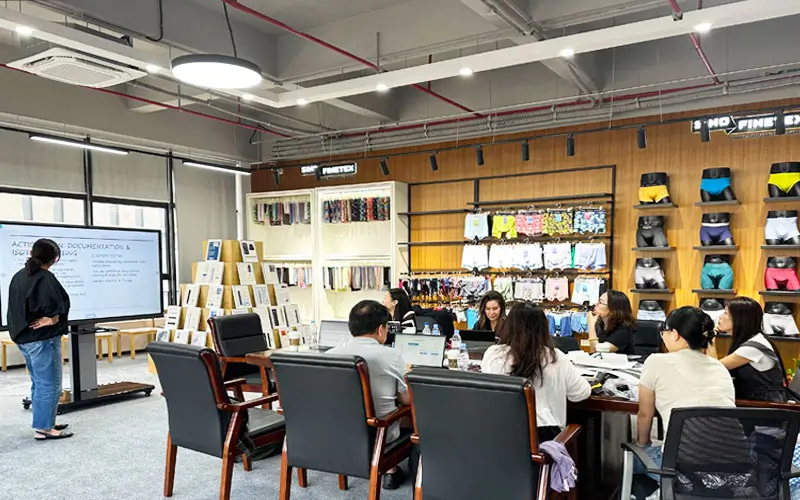
Development: who owns the pattern, the fit block and the graded set?
Agree it in writing before the first order.
Development ownership should cover three separate assets — the digital pattern, the graded size set and the measurement specification — and transferring them is usually a paid step rather than a default.
These three assets are frequently confused with one another. The pattern defines the shape, the graded set defines how that shape changes across sizes, and the measurement specification defines what will be checked on arrival. A supplier can hold all three, or release the pattern while keeping the grading logic, which is why a buyer who asks only for “the pattern” may end up with a file that cannot be reproduced elsewhere without re-grading.
The commercial structure that works for both sides separates the reusable block from the specific pattern. The supplier keeps the block it uses across its own range and releases the specific pattern and grading for the style the brand paid to develop. Buyers should specify the file formats and the deliverable list, and treat the published ASTM body of textile and apparel standards as the neutral vocabulary for describing what the file set contains.
Fabric and trim sourcing: who buys, who carries the risk, who holds stock?
Risk follows booking, not sewing.
Whoever books the fabric carries the minimum, the lead time and the stock risk; a supplier that books on the brand’s behalf normally passes the commitment back through a deposit or a material agreement.
Fabric is the longest lead item in most apparel programmes, so the party that books it controls the critical path. When the supplier books, it can usually negotiate better terms and combine the brand’s requirement with similar work, which lowers the entry quantity but also concentrates information about the brand’s volumes inside the supplier. When the brand books directly, it keeps the specification and the mill relationship, but it also takes the minimum, the inspection duty and the risk of surplus.
The intermediate position is the common one: the supplier books, the brand approves the mill and the specification, and the material agreement records who owns leftover stock and whether it can be used for other buyers. Buyers should also ask who inspects the fabric on receipt and against which standard, because shade variation and weight tolerance discovered after cutting cannot be remedied economically.
That receipt standard is worth naming in the agreement. The widely used baseline for material safety testing is OEKO-TEX Standard 100, and third-party laboratories publish the test scope they apply to apparel textiles, such as Intertek’s textiles and apparel testing range. Naming the standard turns “good quality fabric” into something that can be checked.
The sampling ladder: what each sample stage is for
A development programme usually runs through three distinct samples, and each one resolves a different question. The proto or first sample asks whether the construction works at all. The fit sample asks whether the measurements and the block match the intended body and market. The pre-production sample asks whether the materials, trims and finish that will be used in bulk are the ones that were approved. Collapsing these stages saves calendar days and moves the discovery of problems into production, where the corrections are most expensive.
| Stage | Question it answers | What it should lock |
|---|---|---|
| Proto / first sample | Does the construction function? | Construction method, component placement, basic proportions |
| Fit sample | Does it fit the target market? | Measurements, fit block, grading direction |
| Pre-production sample | Will bulk match what was approved? | Fabric, colour, trims, labels, finish, packing |
The sample approval protocol used for wholesale programmes describes how each approval should be documented, which matters more than the number of rounds: an approval that is not recorded in writing is not an approval.
Production and in-line control: what a service provider should report
Reporting is where a full-service claim is either substantiated or quietly abandoned. A supplier running effective control should be able to tell the buyer when cutting started, whether the marker yielded the planned consumption, when the first bundles were sewn, what the in-line check found, and when the goods were finished and packed. Without that sequence the buyer has no way to distinguish a programme that is on plan from one that is quiet because something has gone wrong.
The content of the reporting matters as much as its frequency. Useful in-line findings are specific: a measurement drifting outside tolerance on one size, a shade band difference between rolls, a print placement that sits outside the approved position. Generic statements that production is proceeding normally carry no information. Buyers should agree the report format before the first order and nominate the person who receives it, because an update sent to a shared inbox is an update nobody owns.
Where a programme also carries a labour or workplace-compliance requirement, the reporting expectation shifts from the garment to the site. Better Work, run jointly by the International Labour Organization and the International Finance Corporation, and the ILO’s textiles sector programme both describe the assessment frameworks buyers commonly reference.
Finishing and packing: the last ten per cent that decides retail readiness
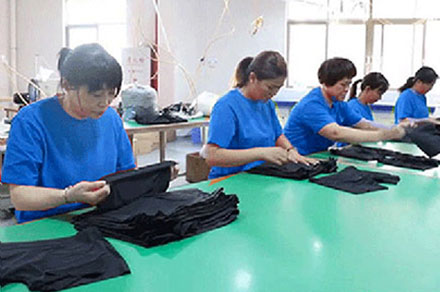
Finishing determines whether a garment that was correct off the line is still correct in the carton. It covers trimming and thread removal, spot cleaning, pressing, measurement verification against the approved specification, folding to the agreed presentation, and packing to the carton plan. It is also the stage where the brand’s labelling and packaging decisions stop being documents and become physical goods, so any artwork that was approved late produces rework here rather than earlier where it is cheaper.
Two details are worth writing into the scope explicitly. The first is the approved folded presentation, because a change in folding changes carton counts and therefore freight. The second is the packing standard, including polybag specification where the destination market regulates packaging, carton marks, and whether the carton is packed to a stated piece count or to a stated weight limit. These are unglamorous items that decide whether a retail partner accepts a delivery without re-packing it.
What a scope-based quote should itemise
A quotation that shows only a unit price cannot be compared with another quotation, and it cannot be audited when something changes. A scope-based quote separates the development work, the material, the make, the decoration, the packing and the delivery terms, so that a change to any one of them can be priced without renegotiating the whole order.
| Quote line | What it should state |
|---|---|
| Development | Pattern, grading and sample rounds included, and the fee for additional rounds |
| Material | Fabric specification, consumption basis, and who carries the minimum |
| Make | Construction standard, size range and quantity basis for the price |
| Decoration | Method, number of positions, and whether setup is charged once or per run |
| Packing | Folding standard, polybag and carton specification, piece count per carton |
| Delivery | Named delivery term, place of delivery and who arranges freight and documents |
How to compare two full-service offers on the same specification
Normalise scope first, then compare the unit price.
Set one specification and one delivery term, list the scope items as included, excluded or optional, and only then compare prices — because the gap between two offers is usually scope, not efficiency.
The mechanics are straightforward once the discipline is accepted. Freeze the specification: fabric composition and weight, construction, size range, decoration positions, packing standard and delivery term. Then ask each supplier to mark every scope item as included, excluded or priced separately. Most differences then resolve into one of a small number of categories — one offer includes pattern development and the other does not, one books fabric and the other sews on a free-issue basis, one quotes a setup charge per colour and the other per order.
Only after that comparison should the discussion move to the unit price, and it should move with the delivery term attached. The ICC Incoterms rules give both parties the same vocabulary for saying where cost and risk transfer, and comparing an ex-works price with a delivered price without that vocabulary produces a false gap.
How much does it cost to get custom clothes made?
It is a sum of six cost blocks, not a rate.
Cost is the total of development, material, make, decoration, packing and delivery; each block responds to a different decision, so the useful question is which blocks the buyer can influence.
Development is a fixed cost that falls as volume rises, which is why a first order always carries a higher effective unit cost than a repeat. Material is driven by the fibre, the weight and the minimum the mill will run. Make is driven by construction complexity and the number of operations per garment. Decoration is driven by method and by how many positions are printed or embroidered. Packing is driven by the presentation standard and the carton plan, and delivery is driven by mode, volume and term.
Because the blocks behave differently, the most useful cost conversation is not a comparison of totals but a review of which block is out of line. A quote that is high on material and normal elsewhere is a specification question. A quote that is high on make is a construction question. Buyers who ask for the six blocks separately get an answer they can act on; buyers who ask for a unit price get a single number with no lever attached.
How do I get my clothing designs manufactured?
Start with a specification, then a sample, then bulk.
Turn the design into a technical pack with measurements and materials, approve a fit sample and a pre-production sample, and only then commit to bulk against a written standard.
The sequence matters because each step produces the input the next one needs. A design becomes a specification when it has measurements, construction notes and materials. The specification becomes a sample when the supplier makes it once. The sample becomes a production standard when it is approved in writing, including any corrections. Bulk then runs against that standard rather than against an interpretation.
Two practical preparations shorten the process. Have the artwork and label text ready before sampling, so that the pre-production sample can carry the final branding rather than a stand-in. And decide the delivery term and destination early, because packing and documentation requirements are set by the route and the market, not by the garment. Programmes that reach the packing stage before those decisions are made tend to lose their schedule at the end, when there is no calendar left to absorb it.
Conclusion
Full service is best understood as a list of handoffs with a named owner for each, rather than as a promise of convenience. The scope items that decide whether a programme runs cleanly are the pattern and grading position, the fabric booking and risk, the trim and label gate, and the packing standard, and none of them are visible in a unit price. Buyers who freeze a specification, mark each scope item as included, excluded or optional, and compare offers on that basis get a price they can audit. The same discipline makes the sampling ladder useful, since each sample stage only resolves its question if the stage before it was approved in writing.
Next step. If you are comparing suppliers, send the scope list you are working from. The team can mark each item as included, excluded or separately priced for your category, so the comparison is made on one specification and one delivery term.
FAQ
Does full service mean the supplier can also design the collection?
Not necessarily. Full service normally describes manufacturing scope: development, materials, making, finishing, packing and documentation. Design capability is a separate question, and a supplier that offers both should be asked which part of the range is original development and which is drawn from its own catalogue of existing styles.
Should we supply our own fabric to reduce cost?
Supplying your own fabric can reduce cost if you already have a mill relationship and can meet the minimum, but it moves inspection duty, lead-time risk and surplus stock onto you. If the supplier books the material, agree who owns leftover fabric and whether it can be used for other buyers.
How many sample rounds should a programme include?
Three stages are normal: a proto to prove the construction, a fit sample to settle measurements, and a pre-production sample to confirm the materials and finish. Additional rounds are legitimate, but each one should be triggered by a recorded comment on the previous sample rather than by a general preference.
What should an in-line production report contain?
Specific findings rather than reassurance: measurements drifting outside tolerance, shade band differences between rolls, print placement outside the approved position, and the corrective action taken. Agree the format and nominate the recipient before the first order so that the report has an owner.
