
Buyers compare factories on price and capability, and the variable that most changes the day-to-day experience is neither. It is structure: how many machines the floor runs, who owns them, whether the pattern room is inside the building and where your order sits in the allocation queue. Two suppliers with identical equipment lists can behave completely differently because one owns its floor and the other books capacity on someone else’s.
Why factory size changes the working experience more than the price
Size sets the minimum, the priority and the flexibility you get. A small floor adapts to your order but cannot absorb a failure; a large floor absorbs failures but allocates capacity by order value, which is rarely in a new buyer’s favour.
Price is a consequence of size rather than the other way round. A larger floor spreads its overhead over more units and buys material in larger quantities, so its unit price is often lower. What it does not do is give a small order priority, and the experience of working with it is therefore shaped by where that order sits relative to everyone else’s.
Three questions describe a factory’s structure more precisely than its headcount. How many lines can run at once, and how many are currently committed. Whether the pattern room and the sample line are inside the building. And who owns the equipment, because a floor that is leased out line by line is a cluster of workshops wearing one address.
| Structure | What you gain | What you accept |
|---|---|---|
| Small workshop | Flexibility, low minimums, direct contact with the owner | Limited backup if a machine fails or a key operator leaves |
| Mid-size factory | Repeatable process, in-house sampling, manageable minimums | Needs committed volume to keep your slot |
| Large factory | Broad capability, developed compliance systems, material buying power | Higher minimums and an allocation queue |
| Trading company | Aggregation of several factories and a single point of contact | A margin and a layer between you and the floor |
Small workshops: flexibility, risk and what they cannot do
A small workshop earns its place through flexibility. It will take an order that a larger factory would decline, it will change a specification without a committee, and the person who answers your message is usually the person who can decide. For a first order, a test order or a style that is genuinely unusual, that flexibility is worth more than a few cents per unit.
What it cannot do is absorb a shock. A single coverstitch machine out of service, a key operator leaving, or a fabric delivery arriving late are all survivable events for a large factory and stoppages for a small one. The risk is structural rather than a matter of competence, and it is managed by keeping orders small relative to the floor’s capacity and by knowing which operations are single points of failure.
Three checks are worth making before placing work with a small workshop. Which operations it performs in-house and which it sends out, since a workshop that outsources the critical stitch is really a coordinator. Whether the equipment is owned or borrowed, because a line that depends on rented machines is not a fixed asset. And what happens to your order if a larger one arrives, which is a question about loyalty as much as capacity.
Mid-size factories: the usual sweet spot and its limits
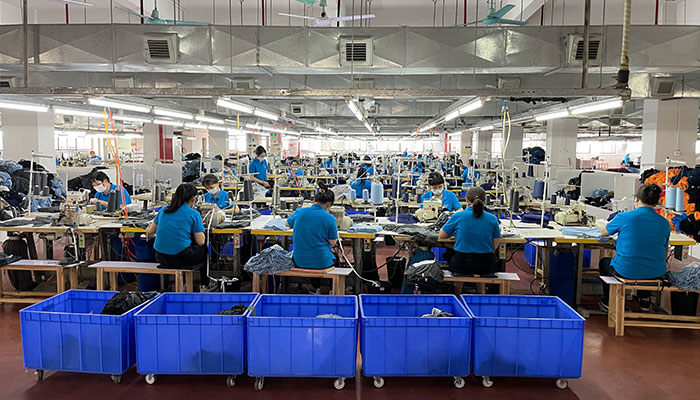
The mid-size factory is where most first production orders land, and the reason is procedural rather than sentimental. At this size a factory usually has a pattern room inside the building, a quality routine that runs without the owner standing at the line, and enough lines to open a second one if an order grows. Minimums exist but are set by the fabric booking rather than by the need to fill a whole floor.
The limit is that the sweetness depends on your volume being meaningful to them. A mid-size factory that takes a small order will do so as fill, and fill is the first thing to move when a larger customer arrives. That is not bad faith; it is how capacity is allocated everywhere. What protects the order is a schedule that does not sit immediately before the factory’s peak.
Two questions tell you whether the relationship is real. Whether the factory will name the line your order would run on and the dates around it. And whether you speak to the same person about sampling and about production, because a change of contact between the two stages usually means the order has changed hands internally.
Large factories: capability, minimums and priority tiers
A large factory offers what a small one cannot: breadth. Several categories on separate lines, in-house knitting or finishing, developed compliance systems and material buying power that shows up in the fabric line of a quote. Where a programme needs certification, traceability or vertical integration, size is often the enabling factor rather than a preference. That is also where the compliance evidence becomes checkable rather than aspirational: amfori administers the BSCI framework for workplace assessment, Sedex holds SMETA reports, and Higg publishes the facility-level index used to compare sites.
The price of that breadth is allocation. Large factories commonly operate tiers of customers, and a new buyer starts in the lowest tier, which means the order is scheduled after the committed volume rather than alongside it. Minimums are correspondingly higher, and a factory may decline a small order politely rather than quote it badly.
Two things make the relationship work at this scale. A specification complete enough to be quoted without clarification, because a large factory will not develop your product for you. And a volume commitment that puts the order above the threshold where it becomes fill, which usually means planning the first season’s volume before the first order rather than after it. The questions that reveal how a large factory handles allocation are set out in this guide to the questions to ask a clothing manufacturer.
Trading companies and hybrids: when the middle layer earns its margin
A trading company does not own the machines, and the margin it charges buys aggregation. Where an order spans several styles, several fabrics or several processes that no single factory would run together, the middle layer performs a service: it divides the work, coordinates the schedule and takes responsibility for the whole. Where the order is a single style in a single fabric, the same layer is a cost with no function.
Hybrids are the more common and more confusing case. A company may own a line and also buy capacity from others, or own a sampling room and subcontract production. The structure is legitimate and often efficient, and the question that resolves it is which part of your order would be made on the floor the company owns.
Two checks make the position visible. Which legal entity would be named in the contract, and whether that entity owns the site where production happens. And what the trading layer is responsible for when something goes wrong, since a coordinator that disclaims responsibility for quality is charging a margin for logistics only. The contract also has to name its delivery term explicitly, because the ICC Incoterms rules set out what each term includes and a coordinated order with unclear terms is where responsibility becomes hardest to place.
How ownership structure affects sampling speed
Sampling speed is decided by where the pattern room sits, and that is an ownership question rather than a technology question. A factory with pattern makers and a sample line inside the building can turn a comment around in days, because the person who drafts the block is a colleague of the person who sews the sample. A factory that sends development out has to schedule someone else’s capacity, and the delay compounds with every round.
The structure also decides who owns the pattern. Where development is outsourced, the pattern may live with a third party rather than with the factory or the buyer, which becomes a problem when the style is moved or a reorder is placed. Settling who holds the pattern, the grade and the marker before the first order is far cheaper than negotiating afterwards.
One question makes the whole position clear: if a measurement has to change, who changes the pattern, and how long does that take. The answer distinguishes a factory with a development capability from one with a development supplier.
Capacity, seasonality and whose order gets produced first
Capacity is allocated by a mixture of value, margin, relationship and timing, and only the last of those is under a new buyer’s control. The periods that strain a factory are predictable: the weeks before a national holiday, and the two seasonal peaks when northern and southern hemisphere programmes overlap. An order placed into a peak moves unless the factory has agreed otherwise in writing.
Three practices reduce the exposure. Ask for the production window with dates rather than a duration, so a shift is visible before it happens. Ask which other work would be running alongside yours, because the answer indicates whether your order shares a line. And keep one alternative source qualified for the core construction, not as a threat but because a second qualified factory is the only real protection against a single-point failure.
The seasonal pattern also argues for planning volume across the year rather than in one block, since a factory allocates capacity to the customers whose orders arrive predictably. Where a programme can commit to a repeating slot, that commitment is often worth more in the schedule than a marginally higher unit price elsewhere.
Two external dependencies run alongside capacity and are outside the factory’s control. The labour standards the site is held to, which the International Labour Organization’s textiles programme sets out, and the customs procedures that apply when the goods move, for which the WTO Trade Facilitation Agreement frames what authorities are expected to maintain.
Matching factory structure to your order profile
The match is made on three properties of your order: its size relative to a typical run, how much development it needs, and how steady the demand is across the year. A small order with heavy development suits a workshop or a mid-size factory with an in-house pattern room. A large, low-development repeat order suits a large factory where the specification is stable and the volume keeps the tier high.
The commercial terms follow from the match rather than preceding it. A small workshop will quote a minimum per style but negotiate on scheduling; a large factory will quote a firm minimum and hold to it but will not develop the product. Where a programme is in between, the practical answer is often to place the first order where the development can be done properly and the production order where the volume is economic, which requires the pattern and grade to be owned by the buyer. The terms that make that structure work are described in this explanation of factory minimum order quantity.
Conclusion
Factory size does not make a supplier better or worse; it changes what you get. A workshop gives flexibility and carries single-point risk, a mid-size factory gives repeatable process and expects meaningful volume, and a large factory gives capability and buying power in exchange for higher minimums and an allocation queue. Establish which operations are on the floor, who owns the pattern room, what the production window is with dates, and where your order sits in the queue, and the structure becomes a variable you chose rather than one you discovered.
FAQ
Is a bigger factory always better?
No. A large factory offers capability, material buying power and developed compliance systems, and it allocates capacity by order value. For a first order with development attached, a smaller factory with an in-house pattern room is often the better match.
What is the main risk of using a small workshop?
Concentration. A machine out of service, a key operator leaving or a late fabric delivery is survivable for a large floor and a stoppage for a small one. Keeping the order small relative to capacity and knowing which operations are single points of failure manages it.
When does a trading company earn its margin?
When the order spans several styles, fabrics or processes that no single factory would run together. The layer divides the work and takes responsibility for the whole. For one style in one fabric, it adds cost without function.
How can I tell whether a factory owns its production?
Ask which legal entity would be named in the contract and whether that entity owns the site where the order runs. A hybrid that owns a sampling room and subcontracts production is legitimate, but the answer changes who is accountable.
Next step. If you are choosing between suppliers of different sizes, send the order profile and the development you need. The team can confirm which structure fits, what the minimum would be, and how the production window would be scheduled.
