
A factory profile is a marketing document with a legal edge, and the edge is the part worth reading. Some of what appears on a profile can be checked in minutes against a public record; some can only be checked by asking a question that a real factory can answer immediately. Separating those two categories is what turns a shortlist of impressive pages into a shortlist of suppliers.
Most “top manufacturer” lists are paid placements — how to read them
Ranking lists usually measure scale, not fit: revenue, headcount, export value and directory placement. None of those predicts whether a factory can make your garment, meet your minimum or give your order priority.
The metrics that appear on a ranking are the metrics that are publicly available. Revenue, employee count, export value and the number of countries served can all be assembled from filings, directories and company statements, which is why they appear. What they describe is size, and size is a statement about capacity rather than about capability or fit.
Two reading habits make a list useful. Look for the criterion, because a list that does not state how it ranked is describing its commercial relationships rather than the industry. And read the categories, because a factory that tops a list in one product family may have no competence at all in another, and the list will not say so.
What a factory profile is legally allowed to claim
A business profile is a commercial communication, and the claims on it are subject to the same expectations of accuracy as any other. A statement of certifications, capacity, customer relationships or locations is a representation, and a representation that cannot be substantiated is a risk to the supplier that made it as well as to the buyer who relied on it.
The practical reading is therefore to sort every claim on a profile into one of three groups. Claims verifiable against a public register: the legal entity and its registration number, and any certificate that a scheme publishes in a searchable register. Claims verifiable by asking a specific question: the equipment, the process steps on site, the minimum and the production window. And claims that cannot be verified at all: unnamed customers, unattributed photographs and general statements of quality.
The third group is not necessarily false, and it cannot be relied on. Where a claim falls into it, the correct response is to convert it into something checkable with a question, which is usually possible and always informative.
Verifying a business licence and the unified social credit code
The business licence is the document that establishes the legal identity of the supplier, and in China it carries a unified social credit code along with the registered name, the registered address and the scope of business. Those four items are the ones to compare against everything else: the quotation, the contract, the bank account and the shipping documents.
The critical check is the name, and it is worth doing carefully. The entity that signs the contract, the entity named on the bank account and the entity on the licence should be the same. Where they differ, the divergence may be entirely innocent, such as an affiliated trading arm, and it is also the classic structure in which a payment cannot be recovered if the order fails.
Two secondary checks are worth making at the same time. The registered scope of business, which indicates what the entity is registered to do rather than what it claims to do. And the registered address against the production address, since a supplier may legitimately hold a contract at one address while producing at another, and the buyer should know which is which. The deeper structure of that assessment is set out in this clothing manufacturer audit checklist.
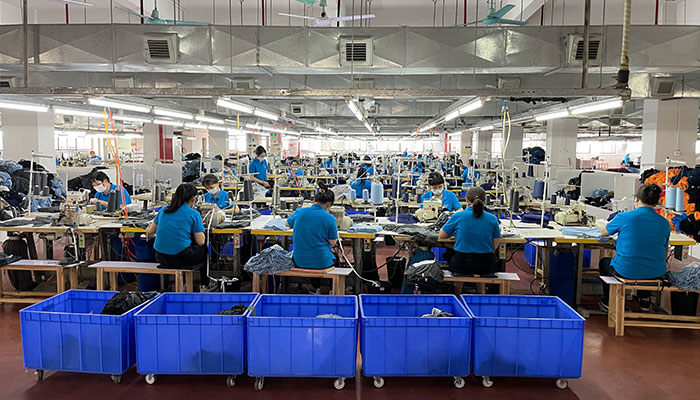
Verifying equipment claims from the photo and video set
Equipment photographs are the easiest claim to check and the easiest to present misleadingly, and the check needs no more than attention. Count the machines of each type rather than looking at the floor, because a photograph of one line can be presented as a factory and the numbers are what matter. Look for the same landmarks across photographs, since a set taken in one building will show consistent windows, pillar positions and flooring, while a set assembled from several sources will not.
The strongest check is a live one. Ask for a short video call while the line is running, and ask the person to walk from the cutting table to the packing area while remaining on camera. A real factory can do this; a brokerage describing another company’s floor cannot, and the request itself often produces a clearer answer than the video would have.
Two follow-ups make the equipment claim useful rather than merely true. Ask which machine performs the operation your garment requires, since an equipment list can be extensive while missing the one that matters. And ask whether the sampling machines are separate from the production machines, because a pattern room with one machine cannot support a bulk programme.
Verifying certifications by certificate number and issuing body
A certificate is verifiable in four steps, and none of them takes long. Find the number and the issuing body, and confirm that the issuing body is the organisation that governs the standard rather than a customer of it. Confirm the holder, because a certificate issued to one entity does not automatically cover another. Read the scope, which names the site or the articles covered. And read both dates, because a certificate valid when the order was placed may not be valid when it ships.
The schemes that publish their scope make this routine. amfori administers the BSCI framework for workplace assessment, Sedex holds SMETA reports, WRAP certifies facilities, and Higg publishes the facility-level index used to compare sites. On the material side, OEKO-TEX Standard 100 states the article classes its certificate covers.
Two failure modes are worth naming. A certificate presented for a category the scheme does not cover, which is a scope problem rather than a validity one. And a certificate that is genuine but belongs to a site that will not make the order, which is the most common way a compliance file becomes decorative. Both are settled by reading the scope rather than the logo.
Verifying customer and reference claims
Customer claims are the least verifiable part of a profile and the part buyers weigh most heavily. A logo wall is a representation that the factory worked with those brands, and it rarely states what was made, when, or whether the work was a sample or a programme. The claim may be accurate and it may tell you very little about whether the factory can make your product.
Three approaches make the claim useful. Ask what was made, rather than who it was made for, since the construction is the relevant fact. Ask for a reference you can contact, accepting that many factories cannot give one because of confidentiality, and treat a refusal as neutral rather than as a signal. And check whether the brand mark is used with permission, since a supplier displaying a protected mark without authorisation is telling you something about how it treats intellectual property; the framework for protecting marks across markets is published by the World Intellectual Property Organization.
The practical conclusion is that references confirm nothing on their own and are useful in combination. A factory that can describe a difficult construction it produced for a named category, and can show the specification for it, is providing evidence. A page of logos is providing an impression.
Verifying capacity claims against your order window
Capacity is the claim most often stated in a form that cannot be checked: a monthly output figure with no reference to what is already committed. The useful question is not how much the factory can produce, it is how much of that is available in the weeks your order needs, and for a first order the second question is the one that decides the date.
Three questions make capacity verifiable. How many lines are running, and how many are committed in the window. Would this order run on one line or be split, and if it splits, when. And where does the order sit relative to the factory’s seasonal peaks, including the weeks around a national holiday. A factory that answers those specifically is describing a schedule; one that answers with an annual figure is describing a brochure.
Capacity claims also change with the order. A figure that was accurate for a large order is not evidence about a small one, because a small order competes for a slot rather than for a capacity percentage. Where a programme is placing a first order, the relevant claim is about priority rather than about volume, and the questions that put a supplier under that kind of examination are set out in this guide to the questions to ask a clothing manufacturer.
The verification checklist to run before a first call
Ten checks take an afternoon and cover the claims a profile is likely to make. The legal entity and registration number on the licence. The match between the licence name, the contract name and the bank account name. The registered scope of business. The production site, named rather than described. The equipment list by machine type and count, checked against the operations your garment needs.
Then the four that concern evidence. The certificates, with number, holder, scope and both dates. The audit reports, with the site in scope and the status of any findings. The material test reports, naming the components being claimed. And the capacity answer, expressed in lines and dates rather than in annual figures.
A final check belongs at the end of the list because it is the one buyers most often skip: whether the supplier will answer a question it does not know, and come back with an answer later. A factory that checks with its pattern room and replies the next day is telling you more about how it will handle a production problem than any page of logos, and the same quality of answer is what the specification depends on. What the assessment looks like when it is run formally is described in this clothing manufacturer audit checklist.
Conclusion
A factory profile is useful once its claims are sorted into what a register can confirm, what a specific question can confirm, and what nothing can confirm. Licences and certificates belong in the first group; equipment, capacity and construction experience in the second; logo walls in the third. Verify the entity and the site, count the machines against the operations your garment needs, read every certificate for its scope and dates, and convert the unverifiable claims into questions. What remains after that is a shortlist that can be sampled rather than a list that can be admired.
FAQ
Can I trust a “top manufacturers” list?
As a starting point for names, yes, provided you check how the list was ranked. Most rankings measure revenue, headcount or directory placement, all of which describe scale rather than whether a factory can make your garment or meet your minimum.
How do I verify a supplier’s business licence?
Compare the registered name and the unified social credit code against the quotation, the contract, the bank account and the shipping documents. The name match is the critical check, because a payment to a third party is difficult to recover if the order fails.
What is the fastest way to check an equipment claim?
Ask for a live video walkthrough from cutting to packing while the line is running. Then ask which machine performs the operation your garment requires, and whether the sampling machines are separate from the production machines.
Do customer references prove anything?
Not on their own. A logo wall does not say what was made or in what quantity. Ask what was produced rather than for whom, request a reference where confidentiality allows, and treat a refused reference as neutral.
Next step. If you are shortlisting suppliers from profiles or lists, send what you have collected and the category you are sourcing. The team can confirm which claims need a document, which need a question, and what to verify before a sample is commissioned.
